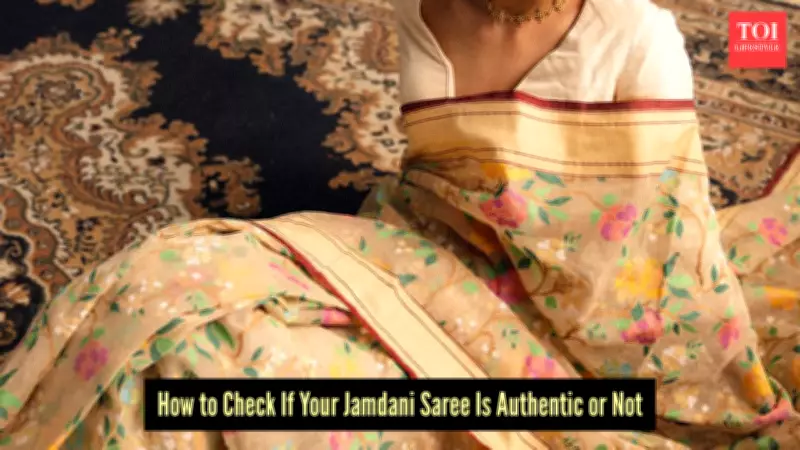
You walk into a boutique, run your fingers over a beautifully sheer fabric, and the tag says "Pure Jamdani." It is priced like a heritage heirloom. You buy it. But what if you just paid a premium for a glorified factory knockoff? Jamdani is supposed to be a triumph of immense patience. Artisans sit at traditional pit looms, manually placing supplementary weft threads to create motifs that look like they are literally floating across sheer muslin. It is a slow, grueling process. The problem? The modern market is absolutely choked with jacquard and powerloom replicas. They look convincing from a distance. Up close, they are a completely different story. Separating a genuine handwoven textile from a mechanized fake requires a discerning eye. You do not need to be a textile historian to figure it out, though. You just need to know exactly where to look.
Perfection is a Massive Red Flag
We usually associate perfection with high quality. With handlooms, it is the exact opposite. True hand-woven textiles carry the subtle, beautiful fingerprint of the weaver. You should look for minor irregularities. Maybe one floral motif is a fraction of a millimeter wider than the one next to it. Perhaps there is a slight, natural unevenness in the base weave itself. These are signs of human hands at work. If a pattern repeats with cold, mathematical, sterile perfection across the entire yardage, it was churned out by a machine. Look closely at the edges of the designs, too. Hand-weaving allows for incredibly sharp, distinct edges on geometric shapes. A mechanical loom cannot replicate an artisan's precise tension control, so the edges of machine-made motifs frequently look blurred or slightly blocky.
The Stretch and Snapping Point
Genuine pieces rely on high thread-count muslin cotton or premium silk. The resulting fabric boasts a distinct translucency, a papery lightness, and an incredibly soft drape that feels like a second skin. Counterfeiters cut costs by sneaking nylon or polyester into the mechanized looms. This synthetic mix ruins the drape. It makes the fabric unnaturally stiff, far less breathable, and slightly scratchy against the skin. If you are evaluating a piece and suspect a synthetic blend, finding a single loose thread reveals the truth. Pure silk or fine cotton will snap neatly when pulled. A nylon-blended thread will stubbornly stretch out like a weak elastic band before it finally breaks.

It Is Woven, Not Stamped
The core identity of Jamdani is that the pattern is the weave itself. It utilizes a discontinuous weft technique. If a design feels distinctly stitched on top of the fabric after the fact, or if it shows any signs of block printing, put it back on the rack. That entirely misses the definition of the craft. For high-investment pieces, always ask for the Geographical Indication (GI) tag. Reputable weavers and boutiques will provide this certification to verify the textile's authentic handloom origins in Bengal. A genuine piece is a canvas of living history. Knowing these structural hallmarks ensures you are actually investing in the craft, rather than falling for a mechanized shortcut.
The Reverse Side Gives It Away
Flipping the fabric over is the single fastest way to catch a scam. Authentic Jamdani is beautifully, astonishingly reversible. Because the artisan hand-places the threads, they are woven seamlessly back into the structure of the garment. The reverse side looks nearly identical to the front. Machine-made imitations cannot replicate this delicate integration. If you turn the fabric over and find a chaotic, messy trail of cut, loose, or thickly frayed threads, you are holding a machine-made fake.