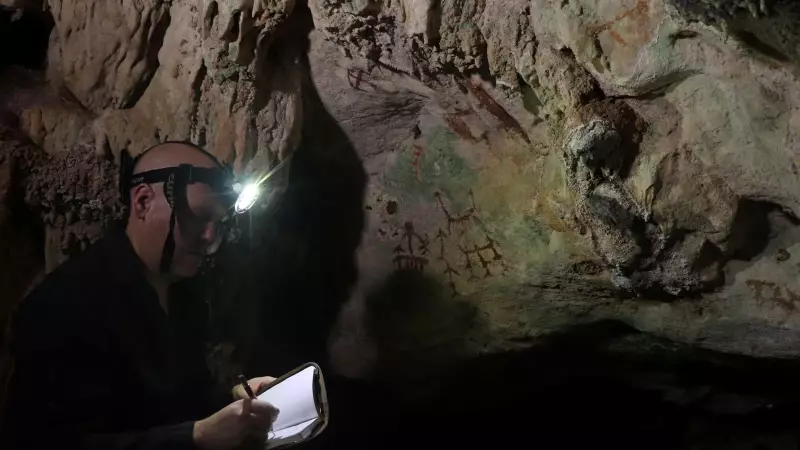
Researchers have identified a painted human hand outline inside a cave on Indonesia's Muna island as the world's oldest example of rock art, created at least 67,800 years ago. This remarkable discovery in the limestone cave of Liang Metanduno, located off Sulawesi's southeastern peninsula, pushes back the timeline of human artistic expression and provides crucial clues about early human migration patterns across Southeast Asia and into Australia.
Ancient Artistic Technique and Cultural Significance
The reddish-colored stencil, though faded and barely visible on the cave wall today, represents a significant early achievement in human creativity. According to the research team, this artwork was created by blowing pigment over a hand placed against the rock surface, a technique that produced distinctive hand outlines found only in Sulawesi.
Maxime Aubert, an archaeological science specialist at Australia's Griffith University who co-led the study published in Nature, noted the unique characteristics of this ancient artwork. "The tips of the fingers were carefully reshaped to make them appear pointed," Aubert explained. "It was almost as if they were deliberately trying to transform this image of a human hand into something else – an animal claw perhaps."

Deeper Symbolic Meaning
Griffith University archaeologist and study co-author Adam Brumm suggested this artistic choice likely held cultural significance. "Clearly they had some deeper cultural meaning but we don't know what that was. I suspect it was something to do with these ancient peoples' complex symbolic relationship with the animal world," Brumm stated.
The researchers determined the minimum age of the image through uranium-series analysis of mineral layers that gradually formed atop the pigment. This scientific dating method provides reliable chronological data for archaeological discoveries that previously relied on less precise estimation techniques.
Comparative Age Analysis
This newly dated hand stencil significantly predates other known examples of ancient rock art:
- It is older than a cave painting at Leang Karampuang in southwestern Sulawesi depicting three human-like figures interacting with a pig, dated to at least 51,200 years ago
- It surpasses the age of rock art in the form of a hand stencil at Maltravieso in Spain, which dates to around 64,000 years ago and has been attributed to Neanderthals
While the specific image described in the research was barely discernible, the team found nearly identical images in much better condition elsewhere in the area, indicating this design was not a one-time creation but part of a broader artistic tradition.
Migration Implications and Australian Settlement Debate
The scientists believe their discovery of the Liang Metanduno hand stencil's age may provide crucial insight into how and when Australia came to be settled by Homo sapiens. The people responsible for this rock art were likely part of a population that traveled from mainland Asia to the Indonesian islands, potentially continuing onward to Australia.
Resolving Chronological Debates
Aubert addressed the long-standing scientific debate about human arrival in Australia: "For many years, scientists have debated when and how the first people reached Australia. One idea is called the 'short chronology,' suggesting people arrived around 50,000 years ago. Another is the 'long chronology,' proposing arrival much earlier, around 60,000 to 65,000 years ago."
The newly dated rock art provides the oldest direct evidence of modern humans in the region, with recent genetic research supporting an earlier arrival time in Australia closer to 60,000 years ago. "Together, the archaeological and genetic evidence now strongly supports the 'long chronology' and shows that the ancestors of Indigenous Australians were moving through Southeast Asia and creating symbolic art as they traveled," Aubert concluded.

Broader Archaeological Context
In earlier research in Sulawesi, the same team documented images of human figures with animal features dated to at least 48,000 years ago. The Liang Metanduno cave itself is already a tourist destination, though visitors typically come to see its larger and more recent paintings attributed to Austronesian-speaking farmers who first appeared in the region around 4,000 years ago.
This discovery not only establishes a new benchmark for the world's oldest rock art but also enriches our understanding of early human migration, artistic expression, and cultural development as Homo sapiens spread worldwide after originating in Africa. The hand stencil serves as a tangible connection to our ancient ancestors and their symbolic world, preserved for millennia in an Indonesian cave.