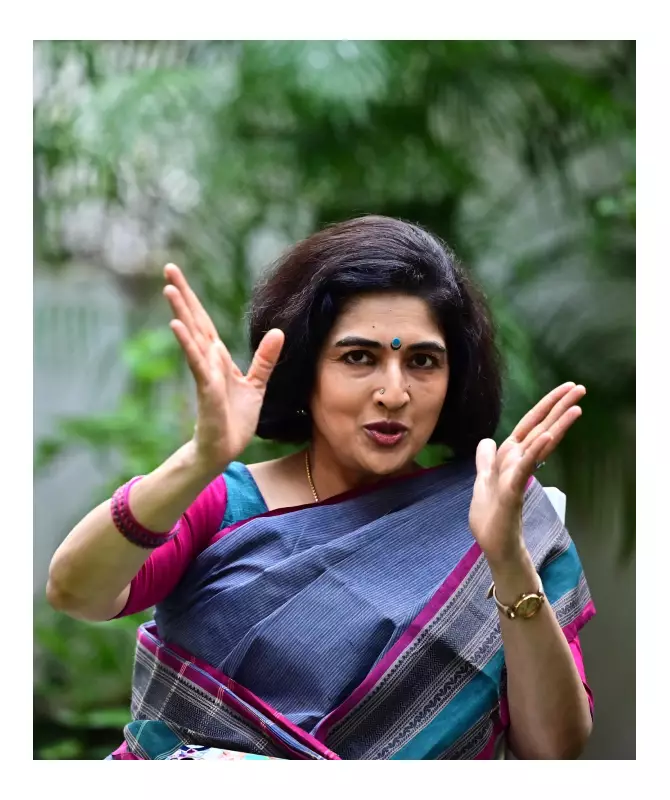
For Srinidhi Chidambaram, a journey spanning five decades in the classical Indian dance form of Bharatanatyam is filled with memories of unconventional teaching, celebrated gurus, and a conscious choice not to institutionalize her knowledge. The 55-year-old dancer, in a candid conversation, traces her path from a four-year-old prodigy to an established artist who has captivated audiences and critics alike.
Ice Cream, Frisbee, and Foundational Lessons
Her initiation into the world of dance began under the tutelage of the trailblazing Kamala Lakshman at Bharatanatyalaya. Chidambaram vividly recalls a pedagogy that balanced serious rigour with delightful surprises. "Ice cream and frisbee were all a part of her classes," she says, painting a picture of a guru who believed in holistic engagement.
Even before her formal arangetram (debut), Lakshman cast a young Srinidhi as the young Bharatha in the play 'Shakunthalum'. Despite parental hesitation, the guru's confidence was unwavering. "She would coax me through my lines with the promise of popcorn, which I loved," Chidambaram reminisces. This early experience instilled a professional ethos: the show must go on, no matter what happens on stage.

The apprenticeship, however, ended abruptly when Kamala Lakshman left for the United States without notice. "It was disappointing, and we felt abandoned," admits Chidambaram. After a trunk call to the US, it became clear a continuation was not feasible, leading her to her next gurus.
The Guru Who Shaped an Artist and a Personal Philosophy
After a brief period with Vazhuvoor Samraj, her training found its anchor in Swamimalai Sri S K Rajaratnam, who taught her at home, accommodating her academic priorities. He remained her guru until his last day. "He was a mentor who helped me understand the nuances of the art, and under his guidance, I blossomed as a dancer," she states.
This deep immersion, however, did not translate into a desire to run a dance school—a question she often encounters. "I don't like to be boxed in," explains Chidambaram, who balances her artistic pursuits with corporate work at Apollo Hospitals and supporting her husband, politician Karti Chidambaram, in his constituency, Sivaganga.
She offers pragmatic advice to parents: while the art is thriving, a career in dance may not always be lucrative. "It is always better to have an educational backup," she emphasizes, advocating for schools and colleges to encourage natya as much as sports.
Accolades, Thematic Innovations, and Inspirations
Chidambaram's talent has earned her prestigious recognition. The legendary critic Subbudu was so taken by her childhood performance as Bala Seetha that he declared a preference for her over mythical treasures. She received the state's highest honour, the Kalaimamani award, from former Chief Minister J. Jayalalithaa at just 19. Former CM M. Karunanidhi, a knowledgeable rasika (connoisseur), was a regular at her performances. More recently, Chief Minister M. K. Stalin appointed her to the governing body of the Tamil Nadu Iyal Isai Nataka Mandram.
Her artistic expression has evolved to include contemporary themes. Moving beyond temple-centric compositions, she recently performed 'Oru Nadhiyin Kadhai' (The story of a river), a poignant piece on Chennai's Cooum river, with lyrics by Vairamuthu. "It spoke about how a river once known for bathing, boating and bonhomie is now left to rot," she shares, highlighting her love for thematic margams that explore poetry, even as her core remains traditional.
Among her inspirations is the iconic Vyjayanthimala, from whom she had the privilege of learning a rare Tanjore quartet varnam. "Her film persona is different, while her stage performances are traditional," notes Chidambaram, admiring the duality.
As she reflects on fifty years, Srinidhi Chidambaram stands as a testament to rigorous training, artistic adaptability, and a life lived beyond a single definition, continually enriching the cultural fabric of Tamil Nadu and Indian classical dance.