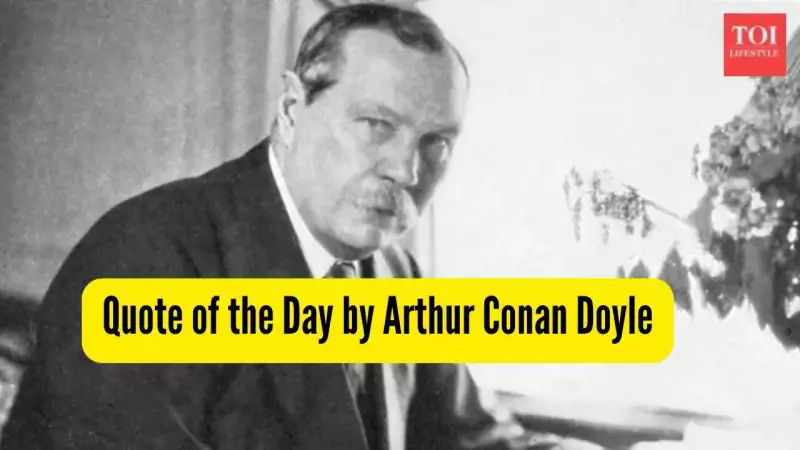
For generations of readers, the name Sherlock Holmes has been synonymous with brilliant deduction and thrilling mystery. The iconic detective, residing at the unforgettable 221B Baker Street, London, was the brainchild of a man whose own life was as fascinating as his fiction: Sir Arthur Conan Doyle.
The Man Behind the Magnifying Glass
Born in 1859 in Edinburgh, Scotland, Arthur Conan Doyle was far more than just an author. He studied medicine at the University of Edinburgh, where he encountered Professor Joseph Bell, a master of observation whose skills directly inspired the character of Sherlock Holmes. Doyle's own life was packed with adventure; he worked as a doctor and even served as a ship's surgeon on whaling voyages to the Arctic and West Africa.
However, writing was his true calling. In 1887, he published A Study in Scarlet, introducing the world to Holmes and Dr. John Watson and revolutionising detective fiction forever. Doyle was a true polymath—a boxer, cricketer, political activist, and a devoted spiritualist. His contributions were recognised when he was knighted in 1902 for his pamphlets defending Britain's position during the Boer War. He passed away in 1930, but his legacy of intellect and creativity endures.

A Literary Universe Beyond Baker Street
While Sherlock Holmes, featured in four novels and 56 short stories like The Adventures of Sherlock Holmes (1892), remains his most famous creation, Doyle's literary genius spanned multiple genres. He was a versatile writer who refused to be confined.
His imagination gave us:
- The Lost World (1912): Introducing Professor Challenger, a prototype for characters like Indiana Jones, this novel envisioned a prehistoric plateau teeming with dinosaurs.
- The White Company (1891): A masterful work of historical fiction celebrating medieval chivalry.
- The Poison Belt (1913): A science-fiction tale that contemplated world-ending gases, showcasing his speculative mind.
- Brigadier Gerard series: Stories filled with Napoleonic-era humour, proving his remarkable range.
His Holmes stories, serialised in Strand Magazine, were so popular they famously saved the publication from financial ruin, blending Victorian atmosphere with a cocaine-laced genius.
Timeless Wisdom in Every Story
Doyle's works were more than mere puzzles; they were vessels of enduring wisdom. Through Holmes, he championed radical empiricism, encapsulated in the famous principle: "When you have eliminated the impossible, whatever remains, however improbable, must be the truth." He taught that careful observation of details—cigar ash, footprints, a watch—was superior to guesswork.
His narratives were deeply moral. They emphasised that justice seeks truth, not revenge, and celebrated the loyal friendship between Holmes and Watson. In The Hound of the Baskervilles, science triumphs over superstition. His science fiction warned against human hubris, while his later spiritualist writings, like The Coming of the Fairies (1922), preached open-mindedness.
Doyle's stories teach resilience, as seen when Holmes returns after "The Final Problem," and foster compassion through the detective's aid to the vulnerable. In an era of sensationalism, Doyle stood for reason.
One of his most profound quotes captures this essence: "The best proof of a man's greatness is how he sees his own smallness." This idea of true maturity and humility—acknowledging one's flaws within a vast world—is a thread that runs through his work and life. It reminds us that greatness lies not in domination, but in self-awareness, a lesson as relevant in India today as it was in Victorian London.