Shishupalgarh: The Forgotten Capital of Ancient Kalinga
Few people remember Shishupalgarh today. This ancient city sits quietly in Odisha's Mahanadi delta, just north of the more famous Nagarjunakonda site. Unlike many historical locations, Shishupalgarh left behind no grand religious monuments. You won't find Buddhist stupas, Jain temples, or Hindu shrines here. This absence explains why the city faded from public memory for centuries.
A Window to Urban Life 2000 Years Ago
Shishupalgarh offers us a remarkable window into urban life that flourished two millennia ago. Located on the edge of modern Bhubaneswar, this site transports us back to a time when India actively connected with wider oceanic trade networks. Empires were rising across continents. Long-distance trade was expanding rapidly. New religious ideas were reshaping societies everywhere.
Within this dynamic landscape, the fortified city of Shishupalgarh emerged as one of ancient Kalinga's great centers. Archaeology suggests the city originated around the 3rd century BC. This was the turbulent period following Emperor Ashoka's brutal campaign in Kalinga. That devastating war transformed Ashoka and redirected Mauryan state policy toward Buddhist values.

Architecture and Urban Planning
The city's massive laterite fort stands perfectly aligned to the four cardinal directions. This precise alignment reflects the growing confidence of early Indian urban planning. Shishupalgarh reached its peak between the 1st century BC and 3rd century AD. During this period, the Roman Empire dominated the Mediterranean while the Han Empire flourished in China.
Traders skillfully connected these distant worlds through sea routes and caravan networks. Odisha's coast played a crucial role in this global system. Archaeological finds at Shishupalgarh include rouletted pottery that echoes Roman tastes. Beads made from semi-precious stones point to exchanges with the Deccan region and beyond.
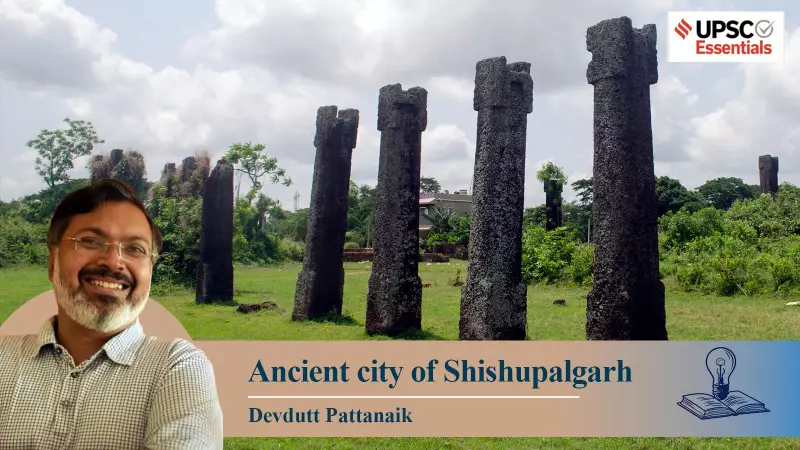
This was more than just a trading hub. City planners designed Shishupalgarh with careful attention to detail. The layout featured organized streets, efficient drainage systems, distinct habitation zones, and monumental gateways. At the heart of the site stands a cluster of carved stone columns. Locals call these the 'solah khamba' or sixteen pillars.
These pillars once formed part of an elevated hall. Scholars believe this space hosted civic meetings or royal ceremonies. Their presence hints at a society with organized leadership and collective gathering spaces. This reflects India's broader transition from tribal chiefdoms to structured kingdoms.
Cultural and Religious Landscape
Shishupalgarh existed during the age of the Satavahanas in the Deccan and the Kushanas in northern India. Indo-Greek, Saka, and Parthian rulers introduced new coins and artistic styles across the subcontinent. The city absorbed these diverse cultural currents while maintaining its distinct Kalingan identity.
Religion in Shishupalgarh mirrored the plural nature of early Indian belief systems. Terracotta figurines reveal a fascinating mix of popular village goddesses, early forms of Durga, tree spirits, and yaksha cults. These belonged to an older stratum of faith rooted in fertility, protection, and local ecology.
Nearby regions show strong Buddhist activity from Ashoka's time onward. Though archaeologists haven't uncovered major monasteries within the city walls, residents clearly lived within a Buddhist cultural sphere. They maintained connections to important sites like Dhauli and Jaugada.
Simultaneously, early Shaiva and Vaishnava symbols appear throughout the wider Kalinga region. This reveals a world where formal religious sects hadn't yet hardened into exclusive communities. People moved freely between different rituals, drawing from a shared pool of myths, icons, and practices. This was a world before caste divisions and religious boundaries became rigidly defined.
The Mystery of the Name
The name Shishupalgarh doesn't actually belong to this ancient world. It represents a later creation of folk memory. The city's original name hasn't survived in any inscriptions. Medieval and early modern villagers living amidst the ruins explained the massive fort walls by linking them to Shishupala.

Shishupala appears as the fiery king in the Mahabharata epic. Such mythological associations are common across India, where abandoned forts often attract stories about epic heroes. When British surveyors arrived in the late 19th and early 20th centuries, the name Shishupalgarh was already in local use.
Some scholars suggest the city's historical name might have been Kalinganagara, mentioned in early inscriptions. However, we cannot confirm this without direct evidence. The name we use today reflects a fascinating dialogue between archaeology and imagination. Archaeology speaks through stones while imagination speaks through stories.
Decline and Legacy
By the 4th century AD, Shishupalgarh began its gradual decline. Rivers shifted their courses, reducing agricultural stability in the region. Trade routes changed direction, favoring other ports along the coast. Political power moved toward emerging centers elsewhere.
As with many ancient places, life ebbed away slowly at Shishupalgarh. Villages grew over the ruins through subsequent centuries. Memory gradually covered history with layers of myth. Yet the stones endure as silent witnesses to a glorious past.
Today, Shishupalgarh stands as one of India's earliest planned urban centers. It was contemporary with great cities across the ancient world. This site reminds us that Odisha, often placed at the margins of grand historical narratives, was once a thriving hub. It connected the Gangetic plains, the Deccan plateau, Southeast Asia, and even distant Rome through extensive trade networks.
The forgotten capital of ancient Kalinga continues to whisper stories to those willing to listen. Its stones speak of urban sophistication, cultural exchange, and India's deep integration into early globalization networks. Shishupalgarh deserves recognition as a crucial chapter in India's rich historical tapestry.