Shimla's Timeless Taste Trail: Century-Old Shops Stand Firm Amid Modernization
In the heart of Shimla, once the summer capital of British India, a culinary legacy persists against the tide of modern cafés, mega marts, and luxury hotels. Historic outlets, some dating back to pre-Independence, continue to define the hill town's identity, preserving flavors and traditions that have endured for generations.
Thakur Bhrata: A Living Archive of Flavors and Resistance
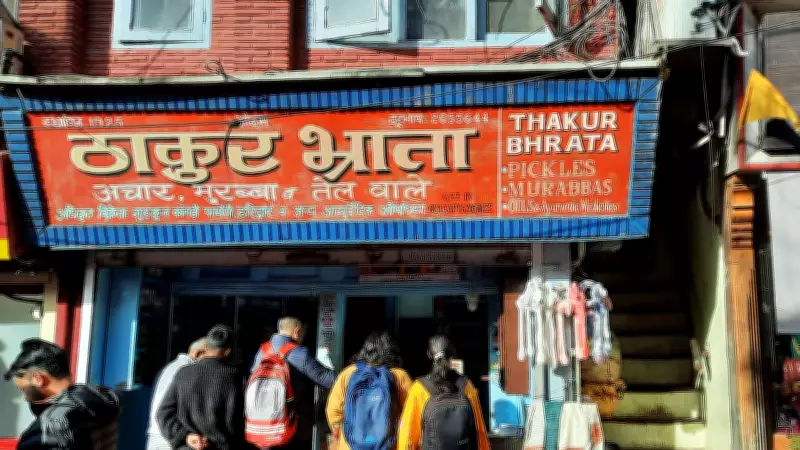
Founded in 1925 by Lala Thakur Das and his brother Prithvi Chand, Thakur Bhrata at Lower Bazar is a testament to resilience. Run by brothers Vijay Kumar, 72, and Rajinder Kumar, 75, the shop originally named Thakur Brothers was subtly Indianized around 1945–46, an act Vijay Kumar describes as "a quiet, symbolic act of resistance." The shop was among Shimla's first to sell sweet and savoury chutneys and pickles, with British officers and locals alike patronizing it for items costing as little as two to four annas.
Remarkably, the shop has preserved original recipes using 150-year-old British liquid battery boxes as storage vessels. These transparent containers, imported from England to power lamps before electricity arrived in 1912, were repurposed by the founders to store achars and murabbas. "Our father recognised their potential as preservation chambers, and for nearly a century they have been reused," Vijay Kumar explained.

Other relics include a reusable accounting slate from 1926, coated with Multani mitti to record transactions, saving paper and costs, and a century-old brass vessel used in prayers. Reflecting on changes, Rajinder Kumar noted, "Today's generation is always in a hurry, while our work remains labour-intensive, with days from 6 am to 8 pm."
Sharma Chat Shop: A Legacy of Taste and Family Tradition
Established in 1937 by Ramesh Sharma's father when Shimla's population was barely 35,000, Sharma Chat Shop in Middle Bazar began as a bakery and evolved into a chaat shop serving kulchas, tikkis, and chole bhature. Ramesh Sharma, who starts his day at 5 am, calls the shop "like my mother—it sustained my family and helped educate my children."
While he intends to continue the business, generational shifts are evident. "My son wants to renovate the interiors for aesthetics, but the food will remain the same," he said. Emotional moments, such as visits from former Bishop Cotton School students from Saudi Arabia, reaffirm the shop's legacy and motivate him to carry forward the tradition.
Frontier Chat Shop: Holding On to a Fading Lineage
Frontier Chat Shop, established in 1933 by Jagannath Sharma from Kangra district, represents culinary continuity but faces challenges. Owner Manu Sharma reflected on its evolution, noting that seating arrangements were introduced around Independence, and only two of the original eight or nine similar shops remain. "Shimla has changed, and so has the shop. We work from dusk to dawn to preserve the original taste, but Chinese and Italian food and café culture have taken over," he said.
Experiments with food delivery platforms proved difficult due to low order volumes. "Preserving the shop's original character is arduous. I am holding on, but the fourth generation will not continue. Neither the work nor Shimla is what it used to be," he lamented.
Historical Perspective and Preservation Efforts
Historian Raaja Bhasin, author of Simla, the Summer Capital of British India, emphasizes that these shops are not merely British-era relics but entities that give Shimla its identity. "These establishments are not trapped in time; they evolve while maintaining heritage," he said. He added that Shimla, as a designated heritage zone, benefits from preservation efforts by the Himachal Pradesh High Court, highlighting the importance of safeguarding the overall historical precinct.
As modern influences grow, these century-old shops stand as pillars of Shimla's cultural and culinary heritage, offering a taste of history that continues to attract loyal patrons and define the town's unique character.