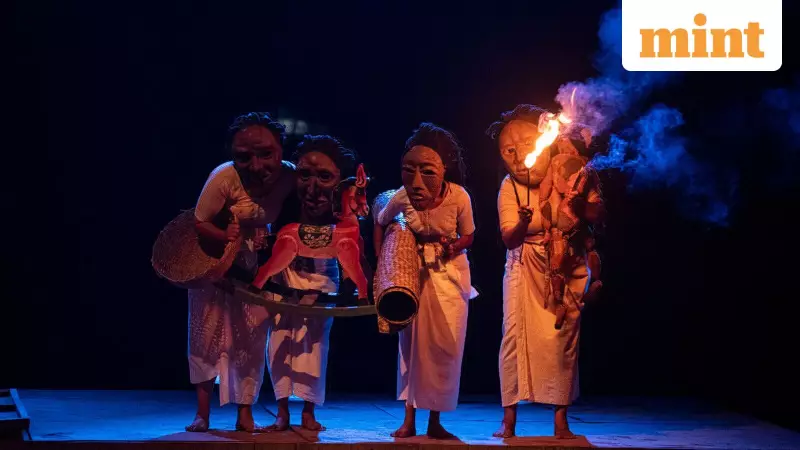
In a small clearing by Panaji's Mandovi riverfront, artist Vidya Thirunarayan recently performed an act that defied easy categorization. Molding clay pots live on stage, weaving together dance, text, and sound, her piece Lives of Clay left audiences pondering a fundamental question: was this theatre, dance, or a ceramics exhibition? This performance, part of the 2023 Serendipity Arts Festival, epitomizes the event's core mission: to dissolve the rigid boundaries between artistic disciplines and foster creative dialogue.
A Decade of Disrupting Artistic Silos
This December, the Serendipity Arts Festival marks its 10th edition, continuing its journey as a catalyst for interdisciplinary collaboration in the Indian arts scene. Scheduled from 12 to 21 December 2025 in Panaji, Goa, the festival will feature an expanded lineup of over 35 curators across diverse fields including music, dance, theatre, visual arts, craft, and culinary arts.
According to Smriti Rajgarhia, director of the Serendipity Arts Foundation and Festival, this milestone edition aims to catalyze new ideas and connections that energize the arts across South Asia. The festival's evolution mirrors a broader shift in India's cultural landscape, where cross-pollination between forms has moved from the fringe to the centre of contemporary practice.

Highlights of the 2025 Edition: From Clay Drums to Blind Birding
The upcoming edition promises a rich tapestry of experiences that challenge conventional formats. Clay Play, curated by Aneesh Pradhan and Shubha Mudgal, will celebrate traditional Goan clay percussion instruments like the samel, ghum, and dhol, evoking local processional traditions.
In the theatre segment, Belgian group Ontroerend Goed presents Handle with Care, a radical experiment with no performers or crew. Instead, a sealed box placed on stage contains instructions for the audience, questioning whether strangers can create something meaningful together in the moment.
The festival also continues its strong commitment to accessibility and inclusion. Curator Salil Chaturvedi returns with initiatives like Blind Date with Friends, now expanded to include people with various disabilities, and blind birding sessions with the Goa Conservation Network, where participants experience birds primarily through sound.
The Curatorial Vision: Returning to a Holistic Ethos
Renowned dancer and curator Geeta Chandran, involved with the festival for four years, argues that the separation of arts into distinct silos is a colonial construct. "Our traditions were never bound by silos. The Natyashastra drew from poetry, theatre, and music," she says. "Serendipity is significant for returning to this inherent multi-disciplinarity within a contemporary context."
This philosophy is evident in returning projects that evolve each year. Visual arts curator Veerangana Solanki, for instance, presents Barge—a series of site-specific interventions at the Captain of Ports Jetty in Old Goa. It builds on her previous work exploring synaesthesia, using sound and sensory discovery to create a "field of imagination."
The festival's location in Goa, away from traditional art hubs, is intentional. It provides a "blank slate" for curators and artists to test new ideas without preconceived notions. The process involves months of advance dialogue, allowing artists time to respond thoughtfully to spaces and concepts.
Reflecting a Larger Shift in India's Arts Ecosystem
The success of Serendipity is not an isolated phenomenon. The last five years have seen India's arts ecosystem widen significantly, with more festivals, museums, and institutional activity embracing collaboration. Jaya Asokan, Fair Director of India Art Fair, observes that interdisciplinarity is now central to contemporary practice in South Asia.
Artists like Rajyashri Goody, who combines food, caste histories, and ceramics, or Afrah Shafiq, who blends gaming with digital archives, exemplify this trend. Sanjoy K. Roy of Teamwork Arts notes that artists are moving between forms with greater confidence, while audiences are increasingly receptive to boundary-blurring experiences.

Hema Singh Rance of the British Council India emphasizes that Serendipity's commissioning of new works provides crucial time, resources, and freedom for artistic exploration. This reinforces the festival's role as a generator of new cultural production, not just a showcase.
The Future of Festivals: Collaboration as a Mindset
As the Serendipity Arts Festival enters its second decade, it stands at a pivotal moment. The role of cultural festivals is evolving globally, with artists building long-term partnerships with ecologists, technologists, scientists, and craftspeople. These collaborations are becoming core to how art is imagined and produced.
Examples like the upcoming Salt Lines installation in Mumbai—examining salt through sound, film, and textile—demonstrate this deep, layered approach. The future of festivals may involve more hybrid and site-responsive models, but one thing is clear: the appetite for collaboration and co-creation will remain a defining feature of the cultural landscape.
For artists like Akhshay Gandhi, whose 2023 collaboration Kahaniyon ka Manthan fused Rajasthani kavad katha with Kerala's Mohiniyattam, the festival has been transformative. It challenged him to move beyond creating spectacle towards genuine creative satisfaction and meaningful interdisciplinary dialogue.
As Panaji prepares to host this decade-celebrating edition, the Serendipity Arts Festival continues to prove that the most compelling art often emerges not from within rigid categories, but in the fertile, uncharted spaces between them.