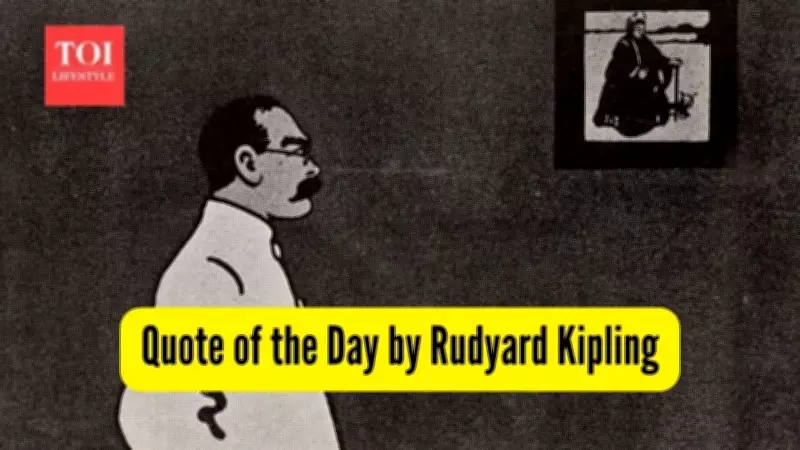
The Formative Years of a Literary Legend
Rudyard Kipling emerged as one of the most significant literary figures spanning the late 19th and early 20th centuries. His remarkable body of work, encompassing poetry, short stories, and novels, provided intricate portrayals of life within the vast British Empire, with particular emphasis on the Indian subcontinent. Kipling's personal journey, creative output, and lasting influence reveal both his extraordinary literary genius and the complex realities of his historical era.
Early Life and Indian Roots
Born on December 30, 1865, in Bombay (present-day Mumbai), India, Kipling entered the world during the peak of British colonial rule. His childhood years in India profoundly shaped his artistic vision and narrative voice. Immersed in India's rich cultural tapestry, diverse languages, and breathtaking landscapes from infancy, Kipling developed a unique perspective that distinguished him from contemporary British authors. This early exposure infused his writing with an authenticity and depth rarely achieved by foreign observers of Indian society.
At just six years old, following a common practice among British families in India, Kipling was sent to England for schooling. This separation from his family and homeland proved emotionally challenging, marked by loneliness and strict institutional discipline. These formative experiences later manifested in the emotional complexity and psychological depth characterizing his fictional characters and narratives.

Journalistic Foundations and Literary Emergence
Returning to India in his late teens, Kipling embarked on a journalism career that fundamentally honed his literary craft. His work as a reporter cultivated essential skills: keen observation, concise expression, and meticulous attention to authentic detail. During this period, he began publishing poems and short stories drawing directly from his Indian experiences. These early works gained immediate popularity for their compelling narratives and vivid imagery, establishing Kipling as a rising literary talent.
Literary Ascendancy and Masterworks
Kipling's relocation to England in 1889 marked the beginning of his international literary prominence. He achieved widespread acclaim for numerous publications, most notably The Jungle Book and Kim, alongside celebrated poems including "If—" and "The White Man's Burden." The Jungle Book remains his most recognized creation, featuring memorable animal characters like Mowgli, Baloo, and Shere Khan within the Indian jungle setting. While often categorized as children's literature, the work explores sophisticated themes of identity, belonging, and survival that resonate across age groups.
Kim, Kipling's acclaimed novel, unfolds against the backdrop of colonial India, tracing a young boy's journey through diverse cultural landscapes while grappling with questions of self-discovery. The narrative is particularly admired for its detailed depiction of Indian life and its exploration of friendship and loyalty across cultural divides. Kipling's poetry, especially the iconic "If—," continues to inspire readers worldwide with its moral guidance and stoic philosophy emphasizing resilience, self-discipline, and integrity.
Recognition and Controversial Legacy
In 1907, Kipling achieved the historic distinction of becoming the first English-language writer awarded the Nobel Prize in Literature. However, his literary legacy remains complex and contested. Kipling's strong advocacy for the British Empire and imperialist perspectives, particularly evident in works like "The White Man's Burden," have drawn significant criticism in contemporary discourse. The poem's suggestion that Western nations bore responsibility for "civilizing" other regions reflects colonial attitudes that modern readers often find problematic.
Beyond his professional achievements, Kipling endured profound personal tragedies. After marrying Caroline Balestier and raising a family, he suffered devastating losses during World War I, including the deaths of his daughter and later his son. These heartbreaking experiences deeply influenced his worldview and literary tone, imbuing his later works with melancholy and philosophical reflection.

Enduring Cultural Impact and Literary Influence
Despite ongoing debates about his political views, Kipling's literary contributions remain undeniable. He played a pivotal role in popularizing the short story format and influenced generations of subsequent writers. His ability to craft engaging narratives using accessible language ensured his work reached broad audiences. Universal themes of courage, duty, and identity continue to make his writing relevant to contemporary readers.
Kipling's cultural impact extends far beyond literature. Numerous film adaptations, theatrical productions, and television series based on The Jungle Book have introduced his stories to new generations worldwide. "If—" maintains its status as one of the most quoted poems in the English language, frequently referenced for character development and personal motivation.
The Inquisitive Mind: Kipling's Approach to Knowledge
Kipling's famous quotation, "I keep six honest serving men (they taught me all I knew); Their names are What and Why and When And How and Where and Who," encapsulates his belief in curiosity and systematic inquiry as pathways to understanding. These six fundamental questions—What, Why, When, How, Where, and Who—create a comprehensive framework for investigation and learning.
Each question serves a distinct purpose in unraveling complexity. "What" identifies subjects or events, "Why" explores underlying causes, "When" establishes temporal context, "How" explains processes, "Where" provides spatial orientation, and "Who" identifies participants. Together, they form a powerful toolkit for critical thinking that journalists, researchers, and students continue to employ. Kipling's emphasis on active questioning reminds us that knowledge requires engagement rather than passive reception, encouraging lifelong learning and thoughtful examination of the world around us.
A Complex Legacy for Modern Readers
In summary, Rudyard Kipling stands as a multifaceted literary giant whose life and work reflect both the brilliance and contradictions of his historical moment. As a master storyteller who vividly brought Indian and global experiences to Western audiences, he created enduring narratives that continue to captivate readers. While some of his ideological positions appear dated or problematic through contemporary lenses, his literary achievements—memorable characters, compelling stories, and significant influence on world literature—secure his place in the cultural canon. Kipling's legacy persists not only in the pages of his works but in ongoing conversations about empire, identity, and the power of storytelling across cultures and generations.