In Pune, a remarkable exhibition is breathing contemporary life into India's ancient artisanal heritage. Titled Miraas, meaning 'inheritance', the event showcases the works of 33 national award-winning artists, each a torchbearer of family traditions that have been nurtured across generations. Held at the Monalisa Kalagram on Pingale Farms in Koregaon Park, the exhibition is curated by the Monalisa Foundation and remains open to the public from 11 am to 8 pm until December 8.
More Than Nostalgia: Tradition as an Active Process
The core philosophy of Miraas is to present tradition not as a relic of the past but as a dynamic, evolving practice shaped by continuous labour, conscious choices, and adaptation. The exhibition floor becomes a testament to this belief, where centuries-old skills find relevance in modern contexts.
One such practitioner is Ashutosh Verma, a sixth-generation master of Sanjhi paper cutting from Mathura-Vrindavan. He explains that Sanjhi is deeply rooted in the lore of Lord Krishna, inspired by Radha's devotional patterns made with natural materials. "I grew up surrounded by this craft," Verma shares. "It is a delicate skill using handmade scissors and paper, learned through observation and practice."

Verma highlights how the craft has transcended its traditional frames. Architects now integrate Sanjhi work into glass partitions, windows, and door panels. His creations have found prestigious homes, including projects for the Parliament and a large installation for the newly built Jewar Airport.
Young Guardians of Ancient Crafts
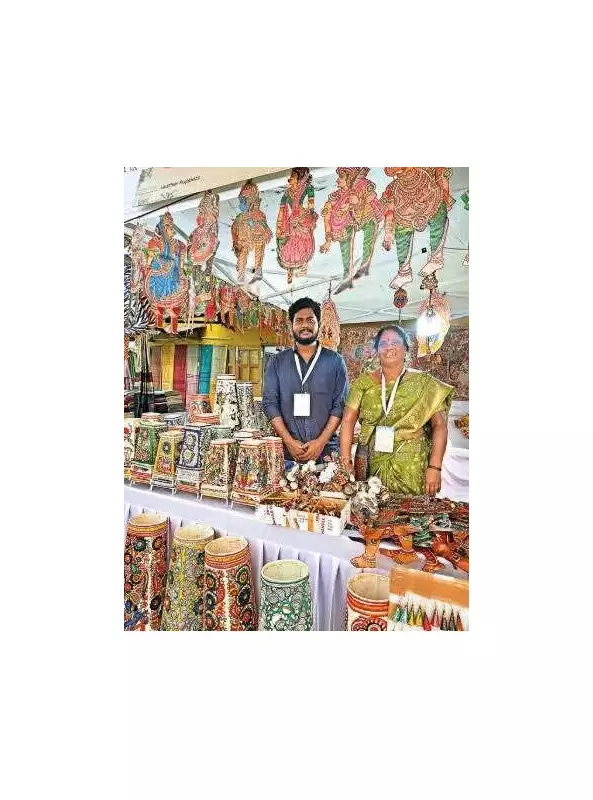
The exhibition powerfully illustrates how the younger generation is consciously choosing to preserve their lineage. Sindhe Chandu (26) from Andhra Pradesh's Nimmalakunta region represents the sixth generation in Charma Chitrakari, a nearly 1,000-year-old art of leather painting and puppetry.
Despite holding a postgraduate degree in computer applications, Chandu turned away from IT jobs. "My father is a national awardee, and my grandfather received the Padma Shri for this craft. I want to carry our legacy forward," he states. The process involves sourcing goat leather, processing it to translucency, drying, and then hand-painting. Delicate holes are punched to allow light to pass, illuminating the vibrant colours.
Chandu has innovated by introducing contemporary products like fairy light shades, earrings, and juda pins. The craft's appeal is global, with significant interest from fashion students. "We conduct workshops for NIFT students across India and have even hosted sessions in fashion institutes in Argentina," he adds.
Miniature Mastery and Natural Dyes
Jai Prakash Lakhiwal, a Padma Shri awardee and miniature painter, clarifies a common misconception. "Most people think 'miniature' refers to size, but it actually denotes the intricacy and style," he explains. He traces the evolution of distinct regional schools like Kangra, Basohli, and Deccan, each identifiable by unique facial features and expressions.
Lakhiwal's process is profoundly traditional, creating everything from scratch—pigments, brushes, and paper—with a single painting taking up to three months. His works grace the Rashtrapati Bhavan (State Corridor, Ashoka Hall), the Prime Minister's office, the Supreme Court of India, and museums in London and France.
Meanwhile, Leheriya expert Badshah Miyan notes a resurgence in demand for old-school natural dyes. "People now seek skin-friendly fabrics and dyes, even though they take longer to make," he says. He also points to international curiosity, particularly from Japanese students drawn to learn this tie-and-dye form due to its similarities with their Shibori technique.
The Miraas exhibition in Pune stands as a vibrant dialogue between a storied past and a creative present, proving that India's craft heritage is not just preserved but is actively being rewritten by its dedicated inheritors.