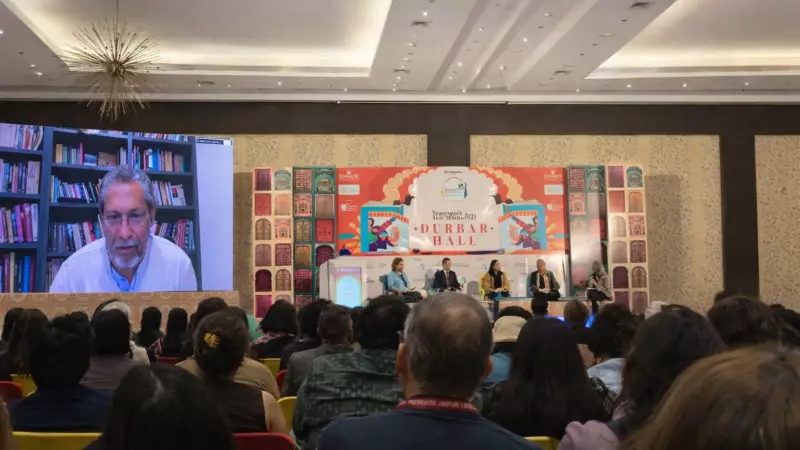
Percival Everett, the celebrated author who won a Pulitzer Prize for his novel James, made a surprise virtual appearance at the Jaipur Literature Festival. His brief but impactful session left attendees buzzing with his candid remarks.
Everett's Teasing Arrival and Sharp Insights
Festival participants had been kept guessing for a day about Everett's non-arrival. On Friday, he finally appeared over a video link for just a few minutes. He used this short time to apologize, provoke thought, and then vanish again, creating a memorable moment.
Speaking about language and power, Everett reflected deeply on how oppressed or imprisoned individuals find ways to survive. He noted they often learn to speak in the manner their enemies expect, a subtle strategy for navigating difficult circumstances.

The Precise Count: Rereading Huckleberry Finn
When asked how often he reread Mark Twain's Adventures of Huckleberry Finn while writing James, Everett gave a characteristically precise answer. He stated he read it exactly fifteen times. He explained his goal was to maintain a critical distance from the original text.
"Ten times is probably love," Everett remarked, suggesting that fewer readings might indicate affection, but his approach required more detachment to reimagine the story effectively.
Unsentimental Views on Twain's Legacy
Everett did not hold back in his assessment of Twain's work. He acknowledged that Huckleberry Finn is an important novel in American literature. However, he firmly stated it is not the greatest work of art ever created.
One reason for this judgment came out bluntly. "I hate Tom Sawyer," Everett declared, dropping a mic-worthy line that highlighted his critical perspective on the character and perhaps the narrative elements surrounding him.
A Theory of Authorship That Drew Laughter
Everett closed his session with a brisk theory about authorship that elicited knowing laughter from the audience. He emphasized that readers matter far more than writers in interpreting literature.
"I don't know what any of my books mean. I wait for the readers to tell me," Everett said. He paused just long enough to build anticipation before delivering his punchline: "And then I take credit for it." This humorous take underscored his view on the collaborative nature of meaning in literature.
Standing Room Only at Another Festival Session
Across the festival grounds, another session titled 'God Particle: The Story of Everything' faced overwhelming demand. The venue was so packed that Marcus du Sautoy, a mathematician and broadcaster who was a central figure on the panel, got briefly stopped at the door by staff.
They asked him to wait until he explained he was one of the speakers. Only then were du Sautoy and his fellow panelists allowed inside. The conversation featured CERN physicist Archana Sharma and astrophysicist Geraint Lewis, aiming to connect the smallest particles of matter with the vast structures of the cosmos.
The Jaipur Literature Festival continues to draw large crowds, offering moments of literary brilliance and intellectual exchange beyond the main stages.