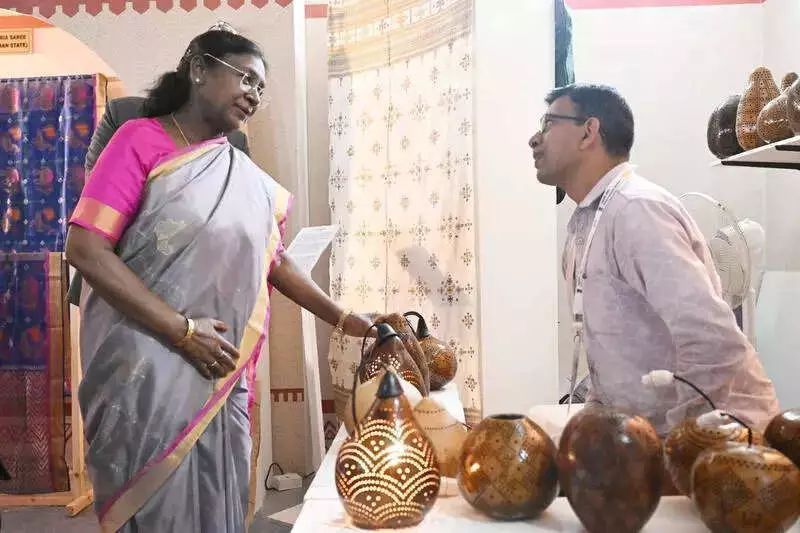
In a moment of profound recognition for a fading tribal heritage, President Droupadi Murmu recently shared a heartfelt interaction with Nagpur-based artisan Sushil Gajbhiye, one of the last guardians of the centuries-old tumba art form. The meeting occurred at the Bharatiya Kala Mahotsav, held at the Rashtrapati Nilayam in Hyderabad—the President's official winter retreat—between November 21 and 30.
A Minute That Made History for a Dying Craft
For Sushil Gajbhiye, a soft-spoken craftsman from Teka Naka in Nagpur, the brief encounter lasting barely a minute was nothing short of historic. Displaying his intricately carved lamps made from hardened wild bottle gourd (tumba), Gajbhiye watched as President Murmu, breaking usual security protocol distances, paused at his stall. She instantly recognized the material. "Main bachpan mein isme pani bharti thi (I used to fill water in this during my childhood)," she told him with a smile.
Gajbhiye, assuming she would move on, was overwhelmed when she stopped, placed her hand on a lamp, and commended his work. "Yeh tumba hai… aap accha kaam kar rahe hain, dharohar ko sambhal rahe hain (This is tumba… you are doing good work, preserving the heritage)," he recalled the President saying. This was Gajbhiye's first direct conversation with the President, though he had participated in three major events inaugurated by her before.

The Last Keepers of Vidarbha's Forest Legacy
The art form that Gajbhiye and his wife Rani practice is on the brink of extinction. Only two families in Maharashtra are known to continue this heirloom tradition. Rooted in the forests of Vidarbha, the craft transforms the wild bottle gourd, traditionally used by tribal communities as a natural container and as the acoustic base for instruments like the veena and santoor, into detailed, glowing lamps.
The 49-year-old artisan maintains a deep, living connection to the land. He personally grows the wild gourds on family farmland near Wardha, harvesting them once a year and curing them for months before the delicate carving begins. While tribals historically etched designs by burning the shell with a heated iron spike, Gajbhiye has innovated gently, using precision tools to create detailed artwork without losing the rustic soul of the tumba.
National Recognition and a Shared Tribal Bond
The meeting at Rashtrapati Nilayam was particularly special as it was held within the President's own residence, and Gajbhiye was the first artisan she visited in the Geographical Indication (GI) pavilion's live demonstration area. His selection for this prestigious event was made by officials from the Ministry of Textiles, including Assistant Director (Handicrafts) Avdhesh Thakur and Handicrafts Promotion Officer Daleep Kumar.
For over a decade, Sushil and Rani have worked side-by-side to turn a dying folk tradition into functional art. Their selection multiple times by the Ministry of Culture and the handicrafts department is a testament to their authenticity and skill. The interaction with President Murmu, who also hails from a tribal community, felt deeply personal. "Woh bhi tribal community se aati hain… unko tumba dekhte hi pehchaan aa gayi (She also comes from a tribal community… she recognized the tumba instantly)," Gajbhiye said, highlighting the shared cultural understanding that made the moment profoundly significant for the preservation of this unique art.