Ancient Amazonian Burial Urns Reveal Complex Funeral Rituals and Engineering
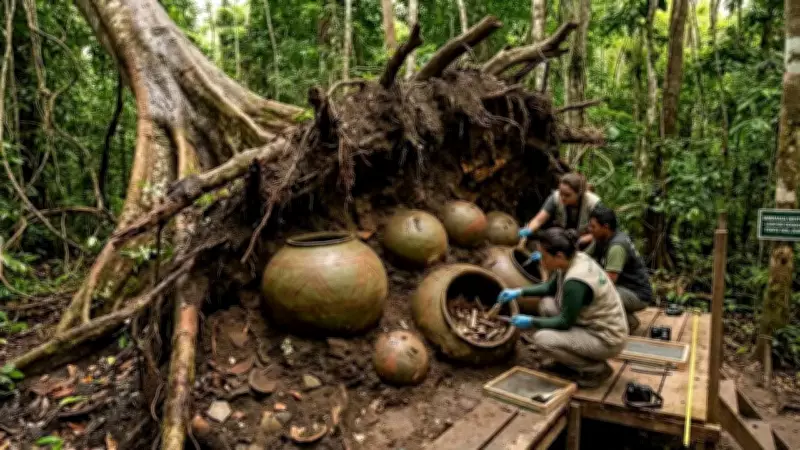
A remarkable archaeological discovery has been made in the Brazilian state of Amazonas, where the uprooting of a paricarana tree at Lago do Cochila led to the uncovering of seven prehistoric funeral urns embedded in its roots. This significant find near Fonte Boa offers a unique glimpse into the engineered landscapes and cultural practices of ancient indigenous societies in the Middle Solimões region.
Ceramic Vessels with Unique Contents
The round ceramic vessels, discovered as part of research efforts by the Mamirauá Institute, contained an unusual combination of human and animal remains. This discovery has profoundly impacted our understanding of burial practices among ancient Amazonian societies. The urns were found at a depth of 40 centimeters beneath an artificial mound, suggesting they were deliberately placed under the floors of homes used by these communities.
The recovered ceramic assemblages, referred to as 'units of the urn,' exhibit a distinctive globular morphology. Most urns measure between 70 and 90 centimeters in diameter and lack any known lids, unlike many other containers found throughout the Amazon. Archaeologists believe they were originally covered with organic materials such as cloth or wooden lids that have since decayed over time.

Engineered Landscapes for Flood Management
The site at Lago do Cochila was surrounded by what researchers describe as 'promotions' - anthropogenic mounds formed from household refuse and other materials. These structures represent ingenious solutions for building on the Amazon's floodplains, known as 'várzea,' allowing communities to maintain settlements despite drastic seasonal water level fluctuations.
This evidence demonstrates that these prehistoric societies were not nomadic but rather built highly organized, settled communities that made substantial alterations to their environment. The artificial islands created by these mounds served as living spaces and ceremonial grounds during seasonal floods, revealing sophisticated environmental adaptation strategies.
Complex Funeral Rituals Revealed
According to findings published in the Journal of Anthropological Archaeology, archaeologists recovered bones of an individual mixed with fish and chelonian (turtle) bones within the urns. Researchers interpret this combination as evidence of complex funeral offering rituals connected to concepts of 'alimentation' or feeding.
The presence of animal bones suggests that burial processes occurred in stages and were conducted symbolically, connecting the deceased with living resources from their aquatic environment. This ritual practice provides valuable insights into the spiritual beliefs and social structures of these ancient Amazonian cultures.
Advanced Ceramic Technology
Recent analysis at the National Museum of the American Indian reveals that the ceramics exhibit a distinct typology, featuring a rare greenish-brown clay decorated with red bands. This style differs from what is typically known as the Amazon Polychrome Tradition, raising questions about unique cultural groups that may have inhabited the Fonte Boa region.
The use of specific minerals to temper the clay indicates that the artisans who created these ceramic products possessed advanced technical knowledge and material engineering skills. This discovery challenges previous assumptions about technological development in prehistoric Amazonia and suggests the existence of sophisticated craft traditions.
Collaborative Preservation Efforts
The recovery of these ancient urns was conducted through collaboration between formally trained archaeologists and members of the Amandarubinha community. Local community members provided crucial assistance in carefully removing the dense root mass that extended over three meters above ground level.
This type of collaborative approach will continue to be essential for protecting Amazonian archaeological sites from environmental degradation and preserving cultural heritage. Such partnerships help prevent unlawful removal of cultural artifacts and ensure that recovered items remain in their proper contextual locations for study and preservation.

The discovery of these seven prehistoric funeral urns represents an important aspect of Amazonian history that remained hidden beneath the rainforest for centuries. These findings contribute significantly to our understanding of how ancient indigenous cultures adapted to their environment, developed sophisticated technologies, and practiced complex spiritual rituals that connected them to both their community and natural surroundings.