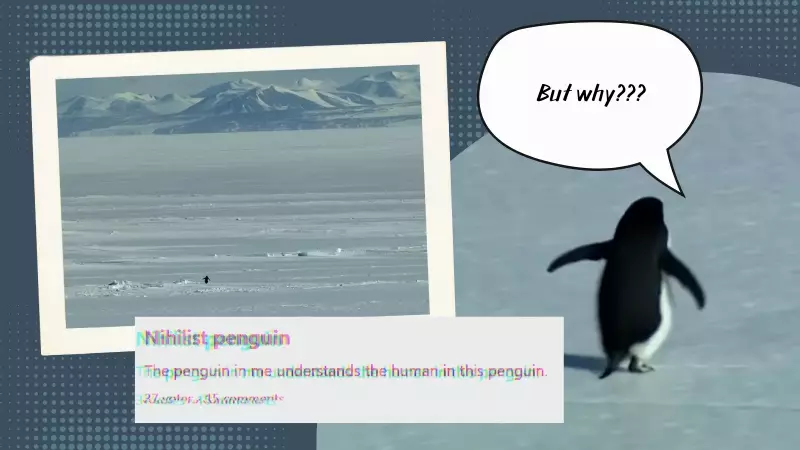
The year 2026 has commenced with unpredictable energy, marked by global nostalgia and profound upheaval. Societies worldwide are navigating shifting geopolitical landscapes and collective emotional losses. Within this turbulent context, an unexpected viral sensation has emerged from the icy wilderness of Antarctica, capturing the digital world's attention and prompting deep philosophical reflection.
The Viral Clip That Sparked a Movement
Footage depicting a solitary penguin deliberately waddling away from its colony toward distant, treacherous mountains has resurfaced from a 2007 documentary. This poignant moment, extracted from German filmmaker Werner Herzog's acclaimed work Encounters at the End of the World, has ignited a massive wave of memes and earnest online discourse years after its original release.
Internet's Philosophical Interpretation
Digital communities have affectionately dubbed this avian wanderer the "nihilist penguin." This label refers to an individual who perceives life as inherently meaningless, rejecting established religious, societal, and moral frameworks. The penguin's apparent defiance has transformed it into an unlikely motivational icon across social media platforms.

On platform X, numerous users have shared profound reactions. One individual declared the penguin "inspired a generation," while another interpreted its journey as teaching humanity that "walking away is wisdom." A flood of pseudo-motivational imagery has followed, creatively captioning the scene with phrases like: "the other penguins survived, but he lived."
Cultural parallels have been drawn extensively, comparing the penguin's departure to cinematic characters who similarly abandoned societal norms:
- Majnu from the 2018 Bollywood film Laila Majnu
- Rahul Jaykar's tragic 'death march' in Aashiqui 2
- Joseph Cooper's purposeful departure in the sci-fi epic Interstellar
Political and Cultural Memeification
The phenomenon has even permeated political discourse. The official White House X account utilized the nihilist penguin imagery to humorously promote a proposed plan regarding Greenland. Their post featured an edited visual of former US President Donald Trump walking alongside the penguin, captioned "Embrace the penguin." This demonstrates how the symbol has transcended mere viral entertainment to enter broader cultural conversations.
The Scientific Reality Behind the Walk
Despite the profound human projections, biological experts provide a more grounded explanation. In Herzog's documentary, lead ecologist Dr. David Ainley explains that penguins can become severely disoriented due to various factors:
- Navigation system failures
- Underlying illnesses or infections
- Extreme environmental stress
These conditions can cause a penguin to wander dangerously far from its colony and the life-sustaining ocean, likely leading to its demise. The documentary narrator specifically explores concepts of "insanity" observed in penguin behavior, suggesting the animal's journey was not philosophical rebellion but biological misfortune.
Anthropomorphism: Assigning Human Emotions
The internet's passionate response highlights a widespread psychological tendency: anthropomorphism. This is the practice of attributing complex human emotions, motivations, and characteristics to animals or inanimate objects. Penguins, belonging to the biological class 'Aves,' are fundamentally aquatic marine birds focused on daily survival in harsh conditions.
Yet, the human mind instinctively layers profound narratives onto this simple avian behavior. Why does a creature merely fighting for existence become a vessel for human existential dilemmas?
The Nihilist Penguin as Modern Allegory
This viral sensation resonates because it reflects contemporary societal exhaustion. For many individuals, the penguin's walk represents a "breath of fresh air" and provides a vicarious sense of liberation. It symbolizes a deep-seated desire to reject relentless modern pressures:

- Constant performance optimization in social and professional spheres
- The pressure to remain productively engaged during leisure time
- Overwhelming materialistic checklists and responsibilities
Today's generation frequently experiences both emotional and physical burnout. The penguin's aimless journey toward uncertainty mirrors a fantasy of abandoning mundane routines, job pressures, and endless obligations. As expressed in the poignant Punjabi folk song Charkha, there exists a universal longing to "leave home and become carefree."
Escaping the Tyranny of Planning
The nihilist penguin embodies a radical rejection of "adulting" responsibilities. It moves forward without a plan, agenda, or concern for consequences—a freedom increasingly elusive in structured modern existence. This imagery prompts introspection: If unconstrained by practicalities, what would we truly choose to do?
Until such personal revelations emerge, the penguin's solitary march into nothingness offers symbolic solace. It represents the quiet rebellion within every individual yearning to temporarily escape societal frameworks and simply exist, unburdened by expectation.
This Antarctic wanderer has thus become an accidental philosopher for our times, reflecting collective fatigue and the timeless human dream of walking away from it all.