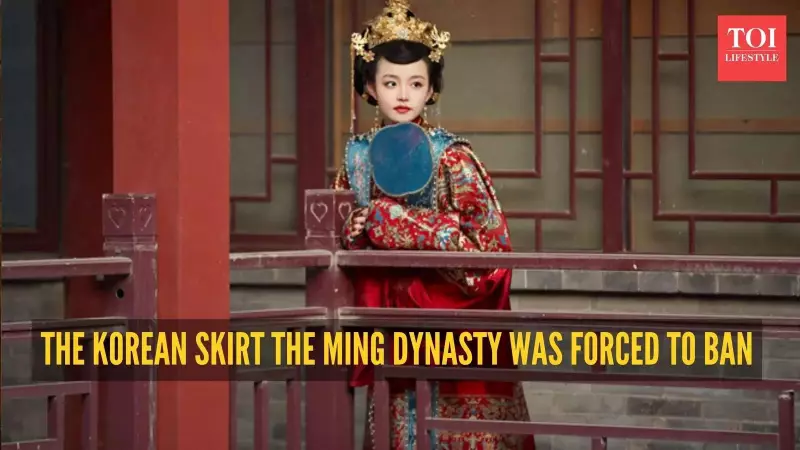
Government crackdowns on fashion trends are not a modern phenomenon. Centuries before contemporary debates over dress codes, China's Ming dynasty found itself confronting a surprising sartorial crisis centered on an unusual garment: a stiff underskirt woven from horsehair.
The Rise of the Maweiqun: A Status Symbol Gone Viral
Long before European crinolines created voluminous silhouettes in the 19th century, Asia had its own version. Known as the maweiqun, this garment was a structured underskirt made from horse tail hair. Worn beneath robes by both men and women, it produced a wide, umbrella-like shape that became a powerful symbol of status and style.
Initially, this fashion item was exclusive to the elite. Historical records indicate that only wealthy merchants, princesses, courtesans, and high-ranking officials could afford it. However, as often happens with trends, the style trickled down and then exploded in popularity. Soon, literati, military officers, and various court officials were all embracing the maweiqun.

The Ming dynasty writer and court recorder Wang Qi provided vivid descriptions of the skirt. He noted that slimmer individuals wore multiple layers to achieve the desired flare, while heavier wearers needed just one. The demand for horsehair, the key material, skyrocketed alongside the trend's popularity.
From Fashion Statement to State Security Threat
The fashion craze took a dark and economically disruptive turn. Horsehair became so valuable that reports emerged of people cutting hair from government-owned horses and even engaging in outright theft to supply the booming market. This direct threat to state resources was the breaking point.
During the Hongzhi period of the Ming dynasty, officials began raising alarms. One supervising secretary warned that the craze was spiraling out of control. The maweiqun was no longer seen as mere clothing; it was framed as a symbol of excess, corruption, and moral decay. In response to petitions, the emperor and his government agreed to an official ban. Almost overnight, the trend collapsed.
Korean Origins and Cross-Border Cultural Exchange
Interestingly, the skirt was not originally a Chinese invention. Scholars widely agree the garment originated in Korea's Joseon dynasty, where it was known as the mamigun. It entered China through cultural exchange. Jeju Island, a hub for horse breeding since Mongol times, played a key role as a center for producing horsehair products, including these skirts.
During Emperor Chenghua's reign, Korean fashion held high prestige among wealthy Chinese elites. This made the skirt both foreign and fashionable—a potentially dangerous combination within the conservative politics of the Ming court. After Emperor Chenghua's death, reformist officials targeted symbols of luxury, and the horsehair skirt became a prime example.
Historians debate whether the craze peaked in Beijing or Nanjing. Some research suggests maritime routes between Jeju Island and China's Jiangnan region may have been more significant than official land routes in spreading this trend, highlighting how fashion often traveled outside formal channels.
The story of the maweiqun is more than a quirky historical footnote. It demonstrates how deeply fashion can influence society, economy, and state policy. It reveals a history of cross-border cultural exchange driven not just by royal courts, but by trade, trends, and human desire—a force powerful enough, in this case, to warrant a royal ban.