In a remarkable year for Indian art, the legacy of the iconic modernist painter Maqbool Fida Husain has witnessed an unprecedented global resurgence. The year 2025 is being celebrated as the grand comeback of the artist, marked by two landmark events: the inauguration of a dedicated museum in Doha, Qatar, and his ascension as the most expensive Indian artist ever at auction. This posthumous glory fulfills a dream Husain harbored for years, realized through the steadfast commitment of a powerful patron.
A Dream Realized: The Lawh Wa Qalam Museum in Doha
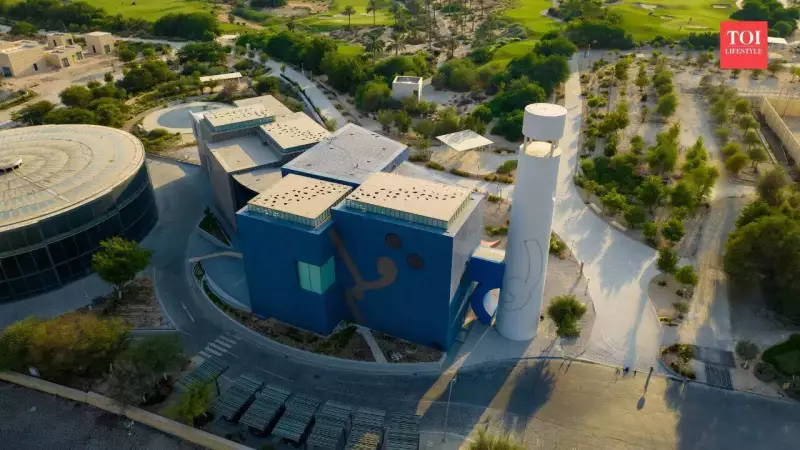
The centerpiece of this renaissance is the stunning Lawh Wa Qalam museum in Doha's Education City. The building, spanning over 3,000 square meters, is the physical manifestation of a sketch Husain made in 2008. Its façade, adorned with thousands of pastel blue tiles, curves towards a grand golden arched door. The museum's name, meaning 'The Tablet & The Pen' in Arabic, was reinterpreted by Husain as him being the author of his life's final chapter.
Architect Martand Khosla, tasked with bringing the sketch to life, engaged in an imaginative dialogue with the late artist's vision. "We were thinking at several levels," Khosla explained, noting the integration of metaphorical elements like cultural links to Yemen and Central Asia within the functional design. The museum's opening gala was a spectacle, with Husain's animated paintings—from Kathakali dancers to galloping horses—projected across the building's exterior, mesmerizing an audience that included Qatari royalty and global art collectors.

A Promise Kept: From Exile to a New Home
This final chapter arrived posthumously, 14 years after Husain's death in 2011, and far from his homeland. It was a promise kept by his friend and patron, Her Highness Sheikha Moza bint Nasser of Qatar. In a poignant letter to the Sheikha, Husain had proposed a museum to house 99 paintings on Arab culture, an installation of crystal horses, and a collection of his Indian heritage. "Please consider me a small soldier in the army of your cultural force," he wrote.
Sheikha Moza's response culminated in the museum's inauguration. "I am delighted to fulfil the dream of this late, esteemed artist," she stated, marking the museum as a new landmark. For Husain, who faced intense protests and death threats in India over some of his works, acquiring Qatari citizenship offered peace and a chance to build his legacy anew. The museum poignantly displays his last used paint palette, brushes, paint-splattered kurta, and his Indian passport—symbols of an identity he relinquished under duress.
Bridging Civilizations: The Collections Within
The museum's two-level collection offers a profound journey through Husain's artistic evolution. One section chronicles his decades of work in India. The other, perhaps more revealing, showcases art created during his time in Doha, including never-before-seen paintings from his unfinished Arab civilization series.
Curator Noof Mohammad highlights pieces like 'The Battle of Badr' (2008), where Husain's famed horses illustrate a historic Islamic victory, incorporating Quranic verses he learned as a child. 'Yemen' (2008) reflects his Arab roots, while 'Zuljanah' (2007) portrays the horse of Imam Hussain. "It will resonate with every visitor that as an artist, you don't need to confine yourself to one medium," Mohammad notes, pointing to Husain's journey from boyhood calligraphy to multidisciplinary mastery.
The collection's finale is the kinetic installation "Seeroo fi al Ardh" (Walk in the Land), conceptualized by Husain in 2009. It is a breathtaking ensemble of Murano glass horses in five colors, a winged sculpture, and vintage cars, all moving in a choreographed performance. Journalist Sahar Zaman, who shared a unique bond with Husain in his final decade, recalls him humming a tune in his red Ferrari, hinting at incorporating the car into a future work—a detail that now lives in this installation.

Husain's creative zenith during this period coincided with personal crisis in India. Though he later apologized if sentiments were hurt, and the Supreme Court upheld artistic freedom, the period was marked by stress. Yet, as Zaman recalls, he always carried India and the language of modern Indian art within him, a language he himself had created.
The year 2025 solidifies M.F. Husain's immortal status. From the record-breaking auction of 'Gram Yatra' for Rs. 118 crores in March to the November opening of the Doha museum, his art continues to bridge Indian and Arab civilizations. The Lawh Wa Qalam museum is more than a building; it is a triumph of the human spirit, a testament to a kept promise, and the glorious, posthumous rediscovery of a modern master who now rightfully stands among the world's top contemporary artists.