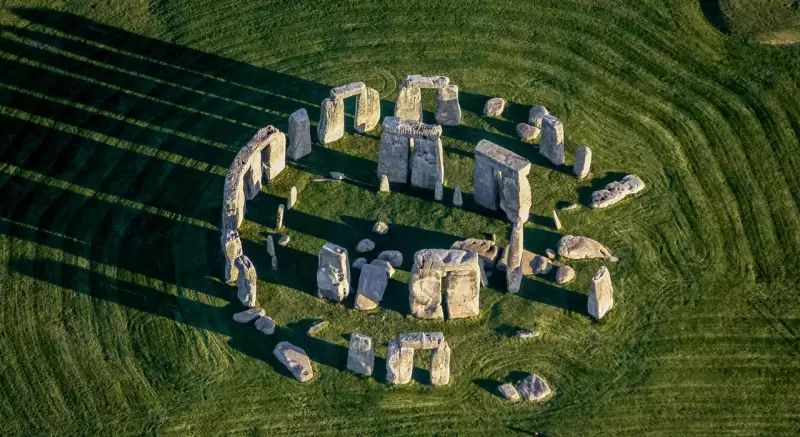
For centuries, Stonehenge has stood as the iconic heart of Britain's ancient past. However, a groundbreaking new discovery suggests it was merely the most visible part of a far more expansive and complex sacred landscape. Researchers have now confirmed the existence of a colossal ring of massive, human-made pits encircling the nearby Durrington Walls, fundamentally altering our perception of the Stonehenge World Heritage Site in Wiltshire.
A Monumental Discovery Beneath the Earth
This newly verified structure, known as the Durrington pit circle, is one of the largest prehistoric constructions ever identified in Britain. It consists of around 20 enormous pits, each approximately 10 metres in diameter and over 5 metres deep, strategically placed at regular intervals. The entire complex was built between 3100 BC and 1600 BC, indicating a sustained and purposeful effort spanning generations.
Professor Vince Gaffney from the University of Bradford explained to the BBC that the precision of the circle is remarkable. The pits are aligned at a consistent distance from the central henge, suggesting careful planning and measurement. "The circle is pretty accurate," Gaffney noted. "It suggests that people were pacing the distances out to make sure that the pits were aligned."

Settling the Debate: How Science Proved the Pits Are Man-Made
When the pits were first outlined in 2020 through geophysical surveys, some archaeologists were sceptical, arguing they could be natural features in the chalk landscape. The new study, published in the journal Internet Archaeology under the title 'The Perils of Pits', aimed to settle this debate conclusively.
Facing the challenge of investigating such large features without a massively expensive excavation, the research team employed a novel, multi-technique strategy. They used high-resolution surveys, electrical resistance tomography, radar, and magnetometry to map the size and shape of the pits underground. The final proof came from analysing soil cores extracted from the pits.
Using optically stimulated luminescence dating, Dr. Tim Kinnaird of the University of St Andrews determined that the pits were dug in the late Neolithic and remained open for roughly 1,000 years. Crucially, sedimentary DNA analysis revealed traces of ancient sheep and cattle within the soil, pointing to human activity rather than natural geological processes. "They can't be occurring naturally. It just can't happen. We think we've nailed it," Professor Gaffney told the Guardian.
Redefining the Stonehenge Landscape: Purpose and Significance
While the exact purpose of the pit circle remains a mystery, its scale and deliberate construction speak volumes. Creating perhaps 20 such massive shafts in hard chalk, accurately spaced over more than a mile, would have required immense coordinated labour and a shared cultural vision.
Archaeologists theorise that this "super henge" may have been tied to beliefs about an underworld, creating a cosmological contrast to Stonehenge's famous alignments with the sun and sky. "Now that we're confident that the pits are a structure, we've got a massive monument inscribing the cosmology of the people at the time on to the land in a way we haven't seen before," said Professor Gaffney.
The fact that the monument was maintained or respected for a millennium indicates its enduring significance, even as cultural practices evolved. This discovery forces us to stop viewing Stonehenge in isolation. Instead, we must understand it as the centrepiece of a vast, intentionally shaped landscape—a testament to the sophisticated beliefs and engineering capabilities of Neolithic Britain that were literally carved into the earth itself.