In a dramatic moment inside a New York courtroom this week, Venezuela's embattled leader Nicolas Maduro made a fervent appeal to a higher power. "In the name of God, you will see that I will be free," he declared, adding, "I am a man of God." Behind this political plea lies a profound spiritual story that stretches thousands of miles from Caracas to a small town in India, rooted in his devotion to the late Indian spiritual master, Sri Sathya Sai Baba.
The Unlikely Spiritual Anchor of a Venezuelan Strongman
Nicolas Maduro, born into a Catholic family in a predominantly Catholic nation, is among several high-profile Venezuelan politicians who became devoted followers of Sai Baba. This group includes his wife, Cilia Flores, a former president of the National Assembly, and the country's acting President, Delcy Rodriguez. For visitors to Maduro's private office in the Miraflores Palace, the evidence was clear: a large, framed portrait of Sai Baba held a place of honor alongside images of revolutionary hero Simón Bolívar and Maduro's predecessor, Hugo Chávez.
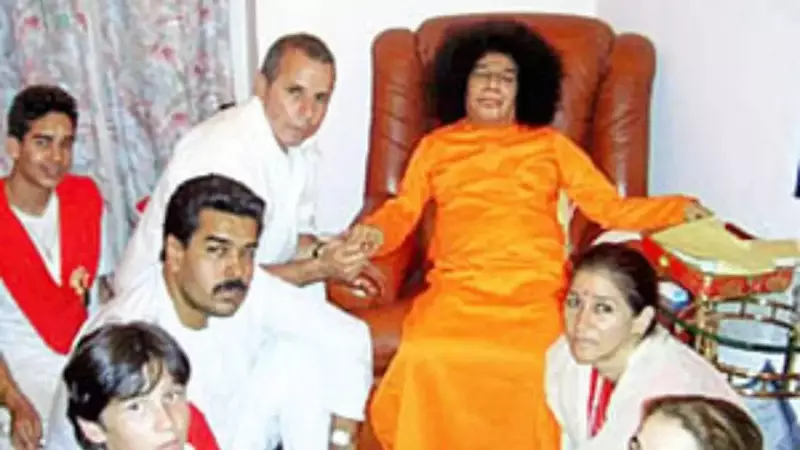
The connection is documented in a 2005 photograph showing Maduro and Flores kneeling during a visit to the guru's Prasanthi Nilayam Ashram in Andhra Pradesh, India. Flores is understood to have been the first in the couple to follow the spiritual path of Sai Baba. More recently, in 2023 and 2024, videos and photos showed Delcy Rodriguez at the same ashram, bowing respectfully.

Maduro's reverence was formal and public. When Sai Baba died in 2011 at the age of 84, the Venezuelan government issued an official condolence resolution and declared a national day of mourning. In a poignant final gesture, just weeks before his regime faced collapse in November 2025, Maduro issued a public statement on the guru's birthday, describing him as a "being of light." He stated, "I always remember him when we met. … May the wisdom of this great teacher continue to enlighten us."
From Andhra Pradesh to the Andes: Sai Baba's Venezuelan Journey
Sri Sathya Sai Baba, born Sathyanarayana Raju in 1926, claimed at age 14 to be the reincarnation of the 19th-century saint Shirdi Sai Baba. Recognizable by his distinctive curly hair, he preached universal messages like "love all, serve all" and "help ever, hurt never," emphasizing selfless service, or seva, as key to spiritual growth. His appeal transcended religion, attracting followers from all backgrounds who incorporated bhajans, chants, and psalms into worship. The official logo for his organizations symbolically incorporated the emblems of five major world religions.
His humanitarian network, the Sri Sathya Sai International Organisation, operated in over 120 countries through free hospitals, schools, universities, and water projects. In the Americas, the organization had a presence in 22 Latin American nations, with Venezuela noted for having the highest concentration of followers. The country was home to more than 30 official centers and small groups, with devotees ranging from Andean communities to Amazonian tribes.
The first Sai Center in Venezuela opened unofficially in Caracas in 1974. Ana Elena Diaz-Viana, elected its inaugural president in 1988, recounted a personal miracle that drew her in. She described seeing a man with an afro in white robes in a dream at age 25, only to recognize him years later in a documentary. In 1988, she joined a group of 64 Venezuelans to meet Sai Baba. She wrote him a letter asking for help for Venezuela's poor and witnessed a red light gleam under his hand as he materialized a lingam, a symbol of divine energy. He gave it to her, instructing her to wash it and "give the water to the poor people of Venezuela who do not have money to buy medicines and for those who are going to die."
A Complex Legacy and the West's Spiritual Inclination
Sai Baba's legacy is not without controversy. A 2006 BBC documentary reported accusations of sexual misconduct by several young male devotees. Furthermore, in a highly speculative 1993 incident, six young male devotees were allegedly killed by police in the guru's bedroom; authorities claimed they acted in self-defense.

The phenomenon of Western attraction to Eastern spiritual guides is not new. From the late 1960s and 1970s, figures like Maharishi Mahesh Yogi, Bhagwan Sree Rajneesh (Osho), and Srila Prabhupada attracted waves of followers. Today, teachers like Sri Sri Ravi Shankar and Mata Amritanandamayi (Amma) continue this tradition. Sai Baba's profound impact on Venezuela's political leadership stands as a unique chapter in this broader cultural exchange, demonstrating how spiritual devotion can quietly shape the corridors of power far from its source.
In Venezuela, the organization's activities were deeply localized. Official talks and meetings were conducted in Spanish, and in 2016, a Venezuelan youth group even introduced a devotional song titled "Mi Destino." This integration shows how the teachings of an Indian guru from Puttaparthi found a resonant home in the heart of South America, influencing a nation's leadership until its most turbulent moments.