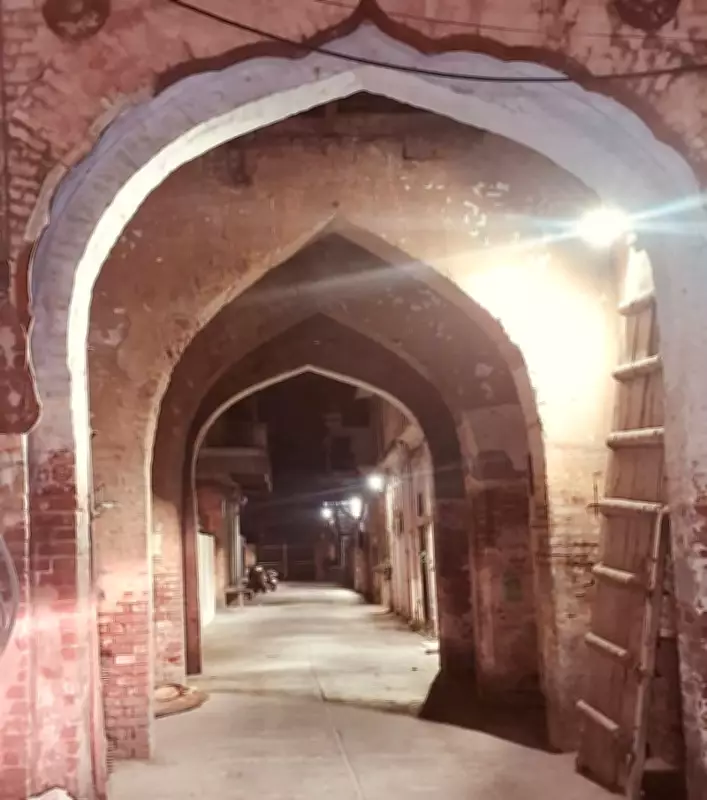
Four walled localities in Ahmedgarh, established by Nawab Ahmed Ali Khan in 1905, continue to foster love and social bonds among residents, even 125 years later. These historic enclaves, located on four sides of Gandhi Chowk, are each protected by two large wooden gates and remain well-preserved.
Historical Background and Layout
According to elderly residents, Nawab Ahmed Ali Khan founded Ahmedgarh in 1905 and persuaded prosperous families from nearby villages to settle there. The walled localities were designed with shared markets and a central community well at Gandhi Chowk. Since most residents were Hindu, spaces were designated for temples such as Durga Mata Mandir, Geeta Bhawan, and Sat Narayan Mandir.
The localities are named after the owners of major portions: Chaudhary Bali Ram Mohalla in the east, followed clockwise by Ashok Puri, Chaudhari Biraj Lal Ahata, and Dharam Dev Mohalla. Biraj Lal Ahata was later subdivided with an internal partition.

Community Planning and Protection
The layout included shops within each walled locality to cater to residents and visitors from neighboring villages. Small shops were also built along the roundabout on all four sides. Ramesh Chand Ghaie, an octogenarian social activist, noted that Nawab Ahmed Ali Khan exchanged land with a Dhulkot landlord family to establish the area's first railway station.
Purshotam Lal Sharma, a former councillor, praised the walled localities for promoting love and culture. “As outsiders were allowed to enter only after screening, women and children used to move freely. Sharing eatables and other household goods was a common practice,” Sharma said. He added that families who have since moved away remain in touch.
Preservation and Modern Significance
The outer gates that once enclosed entire residential areas—named Jand Darwaja, Chhanna Wala Darwarja, Dhulkot Darwaja, and Chhapar Darwaja—have largely disappeared, and their names are nearly forgotten. However, the inner gates of the four walled localities still stand, symbolizing a bygone era of close-knit community living.
These localities continue to serve as a model of social cohesion, where traditions of mutual support and safety persist. The shared spaces and historical gates attract interest from heritage enthusiasts and locals alike.