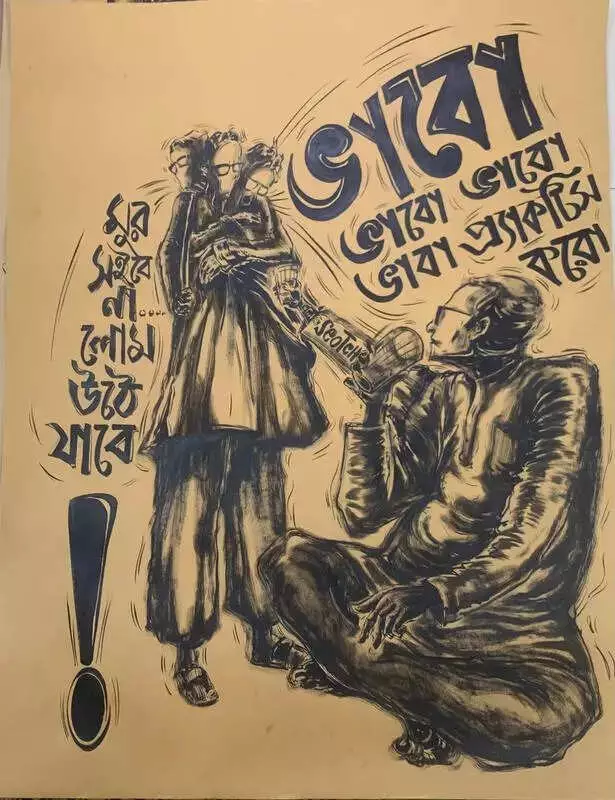
An exhibition in Kolkata is using powerful visual art to revisit the enduring scars of Partition and connect them to contemporary citizenship crises. Titled 'Ritwik Japon', the 10-day showcase commemorates the birth centenary of legendary filmmaker Ritwik Ghatak, whose work often grappled with the trauma of displacement.
Maps and Memories of Displacement
The exhibition features a compelling compilation that documents real-life anxieties. This includes maps, newspaper clippings, and a video recording that chronicle the harrowing experiences of individuals living under the threat of deportation to Bangladesh during the SIR crisis. This installation serves as a stark reminder that the pain of Partition and questions of belonging persist in modern times.
Organized by the Liver Foundation, the initiative was inaugurated on Thursday by Ghatak's son, Ritaban Ghatak. The event saw a poignant moment when Ritaban sang ‘Je Raate Mor Duar Guli' from the classic film ‘Meghe Dhaka Tara'. The inauguration was attended by notable figures including Habibur Rahman Khan, Ghatak's last-surviving producer from Bangladesh, film scholar Sanjoy Mukhopadhyay, artist Hiran Mitra, and actor Debshankar Haldar.

Site-Specific Installations Reimagine Cinematic Legacy
The exhibition, located at the proposed site for the University of Health and Human Sciences, presents eight site-specific installations. These works explore the themes of Ghatak's feature films and examine their relevance in today's world. Curator Sovan Tarafdar detailed the various pieces.
Sourav Banerjee's installation on ‘Komal Gandhar' delves into the idea of love during Partition. A mural by Krishna Banerjee and NaMi-Ridoy on ‘Meghe Dhaka Tara' focuses on the femininity of the character Nita using a wall graffiti style. Suman Kabiraj's work foregrounds the agonised tale of a river, inspired by ‘Titas Ekti Nodir Naam'. Nilanjan Karmakar's photo collage, featuring spaces like airstrips or documents from Cooper's refugee camp, echoes the themes of ‘Subarnarekha'. Debashis Manna pays tribute to ‘Ajantrik' with a junk sculpture.
A Direct Link to Today's Citizenship Debates
One of the most politically resonant installations is Pradip Patra's work on Ghatak's first film, ‘Nagarik'. Titled KYC (Know Your Citizen), it features a video installation that montages scenes from Ghatak's 1977 film with footage of individuals traumatised and imprisoned due to contemporary citizenship disputes.
"Ritwik completed the film in 1952. At that time, he taught us that we must fight to survive. His narrative focused on the division of a nation. Today, the narrative concerns the division of people, with the State determining who is a citizen and who is not," Patra explained, highlighting the chilling continuity of the theme.
In a touching community engagement, artist Mrinal Mandal showed Ghatak's film ‘Bari theke Paliye' to the children of Khwaabgaon. Inspired, most of them drew cityscapes, which are now displayed as backlit slides at the venue.
Baroda-based artist Pritam Das contributed a graphic story installation on ‘Jukti Takko aar Gappo', depicting Ghatak as Nilkantha Bagchi. Among the 20 dialogues he illustrated, one from 1974 feels particularly prophetic today: "Nobin Bangladesh, je Bangladesher ajo jonmo hoyni kintu hobe" (a new Bangladesh, that hasn't been born yet but holds the promise of a new beginning).
Abhijit Chowdhury, chief mentor of the Liver Foundation, shared his personal connection to Ghatak, having first seen ‘Subarnarekha' as a class VIII student in 1972 in his Birbhum village. He hailed Ghatak as an emblem of the highest creative brilliance, whose work delivers "one tight slap at societal hypocrisy." Chowdhury compared him to Luis Buñuel, suggesting Ghatak's global stature.

To mark Ghatak's birth date on the 4th of each month, Chowdhury revealed that a team including Sovan Tarafdar, Sanjoy Mukhopadhyay, Devshankar Haldar, and Suman Mukhopadhyay plans to host regular events. The exhibition itself aligns with the foundation's broader vision for the upcoming University of Health and Human Sciences, which aims to expand the definition of health to include liberal arts, performing arts, social sciences, and climate ecology.