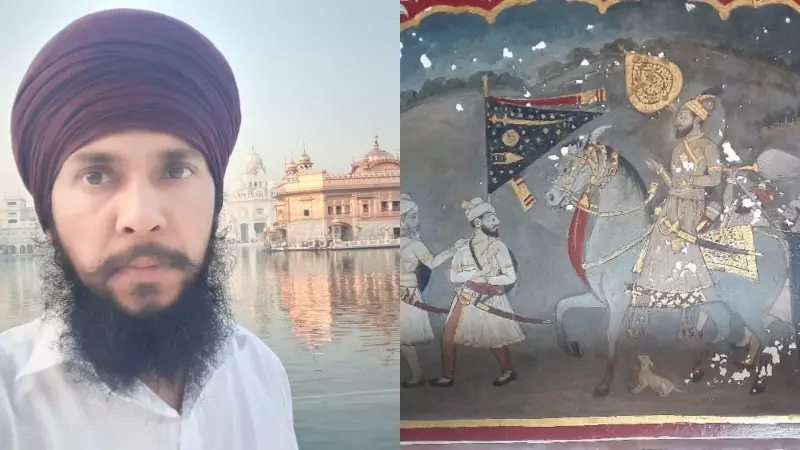
In a remarkable echo of history spanning two centuries, the Golden Temple in Amritsar has turned to the Kangra region of Himachal Pradesh for the delicate restoration of a rare and historic fresco of Guru Gobind Singh. The assignment continues a legacy begun by Maharaja Ranjit Singh, who first commissioned a replica of the painting by hiring an artist from Kangra in the early 19th century.
The Chosen Restorer: A Professor with a Sacred Mission
The monumental task of reviving the aging masterpiece has been entrusted to Balbinder Kumar, an Assistant Professor in the Department of Interdisciplinary Studies at the Indian Institute of Himalayan Studies, Himachal Pradesh University. A PhD in Pahari miniature painting, Kumar hails from Kangri village in Kangra district.
He was first contacted for restoration work in 2021, for old paintings of Guru Tegh Bahadur at the Baba Bakala gurdwara near Amritsar. His expertise led to the prestigious Golden Temple assignment, which he began in August last year.

"I usually come on the weekends from Shimla to do this work. I am not doing it for money. I feel lucky that the Guru chose me," says Kumar, who has embraced the project as a spiritual seva (service). In a personal tribute, he has decided to keep unshorn hair for the duration of the work, following the Sikh code. "It was my own decision, as the Guru guided me," he explains.
A Painstaking Process Rooted in History
The fresco, a fresco secco (painting on dry plaster) created during Maharaja Ranjit Singh’s era, depicts Guru Gobind Singh on horseback with the Panj Piyaras (Five Beloved Ones). Described by scholar Madanjit Kaur, the detailed artwork includes an attendant with a flywhisk, a figure holding a falcon, another carrying the Sikh standard, and even a running dog near the horse.
Centuries have taken their toll. "The fresco secco masterpiece has weathered centuries, its natural pigments flaking due to natural reactions," Kumar notes. His restoration philosophy is strict: use the same historical techniques and natural pigments "without any changes." This involves carefully reapplying layers of color that have detached from the wall over time due to dampness and climate.
The UK-based Guru Nanak Nishkam Sewak Jatha, which manages the gold-plating of the Golden Temple, selected Kumar for this sensitive job. Their representative, Inderjit Singh, stated the historical rationale: "We hired Balbinder Kumar as he comes from the same region, Kangra, from where the first artist who made the painting of Guru Gobind Singh came. We thought he would be the best person."
Carrying Forward a Kangra Artistic Dynasty
Kumar’s connection to this art form is profound and personal. He credits his mother, Rooma Devi, who painted Sikh Gurus, as his first teacher. He was further inspired by the late Samuel Gill, a student of renowned artist Phulan Rani.
His appointment feels destined, linking back to the original painting's history. After conquering Kangra, Maharaja Ranjit Singh discovered what is considered the first and only "realist" painting of Guru Gobind Singh in the collection of Kangra King Maharaja Sansar Chandra. When Sansar Chandra declined to part with it, Ranjit Singh commissioned a replica for the Darbar Sahib (Golden Temple) from an artist from the original painter's family.
Kumar is deeply aware of this legacy. "The other two artists were from Kangra. It is the blessing of the Guru that I have got this opportunity," he reflects. The work, which also involves creating a second copy, is meticulous and time-insensitive. "I cannot exactly say when my work will be completed, perhaps it will take a couple more visits and I will be done by March… Time doesn’t matter here," he concludes, emphasizing the sacred and historical significance of his task over deadlines.