German Explorer Paintings Reveal Himalayan Landscape from 170 Years Ago
Humanity has always possessed an innate curiosity to gaze into the past and understand how the landscapes we know today appeared centuries ago. To satisfy this historical yearning, ancient artifacts and paintings often serve as invaluable windows. One such remarkable collection of paintings has now been unveiled to the public, showcasing one of India's most breathtaking landscapes as it looked nearly one and a half centuries ago.
Himalayan Quest from 170 Years Ago!
For over a century, the works of the Schlagintweit brothers and their Himalayan imagery remained largely confined to European archives, libraries, and museum basements, known primarily to mountaineering historians and Alpine scholars. Now, for the very first time, residents of India are receiving a public glimpse into what the majestic Himalayas looked like nearly 170 years ago, through the eyes of three pioneering German explorer-siblings.
An exhibition titled Himalayan Encounters: Hidden Views from 170 Years Ago brings 77 historic images of the upper Himalayan region to Delhi, offering a rare portal into the colonial-era survey of what the brothers famously termed "high Asia."

What Makes These Paintings Special?
In 1854, the East India Company commissioned three German geologists—Adolph, Hermann, and Robert Schlagintweit—to extend the magnetic survey of the Indian subcontinent. According to historical reports, while the Great Trigonometrical Survey of India was already in progress and much of the "great arc" had been mapped, the northern Himalayan stretches remained only partially explored.
The brothers navigated a complex geopolitical landscape, with Kashmir granting permission, Nepal delaying, and Sikkim outright refusing access. They had to maneuver carefully between British-controlled territories and independent Himalayan states.
Himalayan historian Shekhar Pathak noted that the Schlagintweits were "the first Europeans to use the camera in their surveys in India, and also made paintings over very low-resolution prints of their photographs." They later published their comprehensive findings in seven volumes, combining detailed maps, precise measurements, and rich visual records of the terrain.
A Treasure of Images Comes Home
Of the 77 images currently on display in Delhi, at least five are being shown publicly for the first time ever. These include:
- A breathtaking panoramic view of Dal Lake in Srinagar, elegantly framed by snow-clad mountains
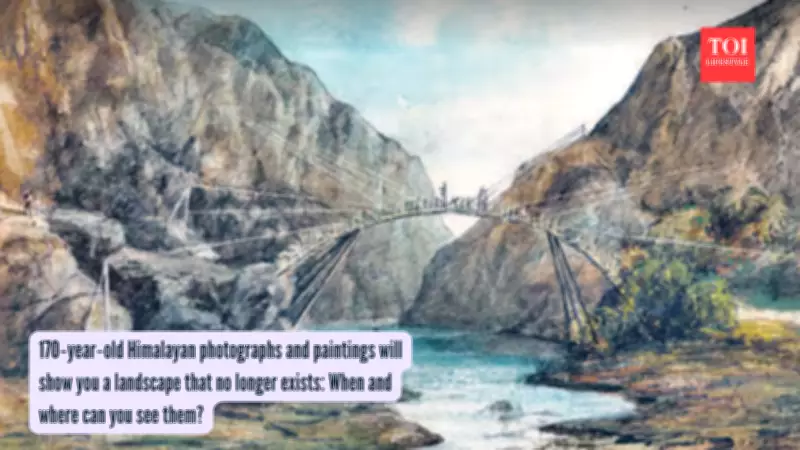
- A depiction of the Bogapani Bridge in present-day Meghalaya, supported on wooden stilts across a rugged hillside
The remainder of the collection captures rivers, temples, clusters of traditional houses, and high-altitude terrain from an era when the primary objective of colonial projects was to map the entire globe, including the most inaccessible corners of the Himalayas.
All displayed works are high-quality prints of the Schlagintweits' original paintings and early photographs, which form part of a larger archive comprising approximately 700 sketches of India and "high Asia."
Bringing the Paintings to India
According to the exhibition's co-curator Hermann Kreutzmann, the initiative to bring these images back to India originated in 2015. This occurred when Pathak visited an exhibition at the Alpines Museum in Munich and encountered paintings depicting Nainital, Badrinath, Kedarnath, Kanchenjunga, Ladakh, and Tibetan monasteries.
Pathak later expressed, "I was delighted to see this khazana of paintings, and immediately began dreaming of exhibiting some of these images in India."
The Schlagintweits' meticulous surveys and maps laid the groundwork for subsequent meteorological and geological studies in the region. Their collections of rocks, minerals, plants, and ethnographic masks are now dispersed across museums in Germany, England, and even Pakistan.

When and Where to Experience These Paintings?
The traveling exhibition will journey from Delhi to Dehradun's Doon Library and Research Centre from May 1 to May 9, followed by a display at Nainital's CRST Inter College from May 12 to May 18. This itinerary provides Himalayan-region audiences with an intimate encounter with their own historical heritage.
In doing so, the exhibition not only resurrects the fascinating story of the Schlagintweit brothers but also powerfully reminds viewers that the Himalayas represent both a living landscape and a living archive of human exploration and natural history.