1897 Royal Dinner Menu Reveals Deep French Influence on Indian Aristocracy
In India, food transcends mere sustenance. It embodies memory, identity, geography, and heritage, served with a rich tapestry of flavor and aroma. Therefore, when a royal dinner menu from 1897 recently emerged online, many anticipated traditional Mughlai chicken, kesari pulao, kheer, or gulab jamuns. Instead, the menu for a dinner between the Maharaja of Gwalior and the Maharaja of Baroda starkly illustrates how colonization shaped Indian elite culture.
A Lavish French Feast in the Heart of India
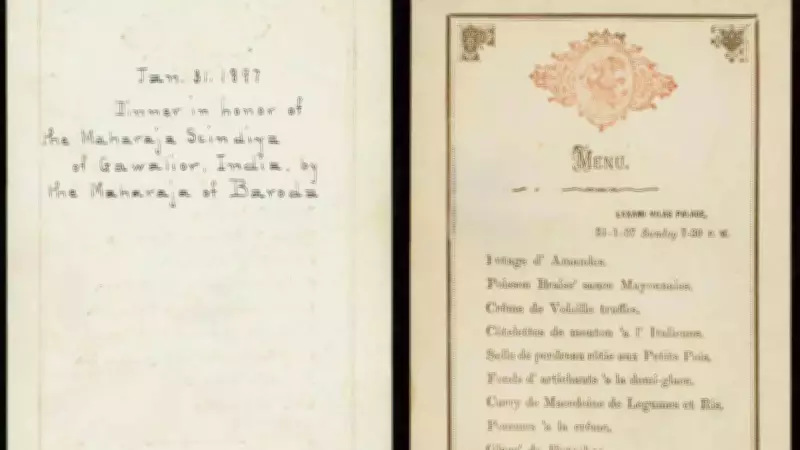
Neha Vermani, a historian specializing in Early Modern South Asia and Food Material Culture, shared images of this historic menu on social media platform X. The menu, adorned with a royal emblem, identifies the venue as the Laxami Vilas Palace, with the date January 31, 1897, a Sunday, at 7:30 PM.
What truly captivates attention is the menu itself. Every course, from soup to dessert, is meticulously listed in French, rather than English or any Indian language. The dishes include:

- Potage d'Amandes (Almond Soup)
- Poisson Braise sauce Mayonnaise (Braised Fish with Mayonnaise Sauce)
- Crème de Volaille truffes (Cream of Chicken with Truffles)
- Cotelettes de mouton a l'Italienne (Italian Mutton Chops)
- Selle de perdreau rotie aux Petits Pois (Roasted Partridge Saddle with Peas)
- Fonds d'artichauts a la demi-glace (Artichoke Bottoms with Demi-Glace)
- Curry de Macedoine de Legumes et Ris (Vegetable Curry with Rice)
- Pommes a la crème (Baked Apples with Cream)
- Glace de Pistachoo (Pistachio Ice Cream)
An accompanying note clarifies that the dinner was hosted by the Maharaja of Baroda in honor of the Maharaja Scindiya of Gwalior. Vermani noted that the menu photos were sourced from an archive in the United States.
Social Media Reactions: Surprise and Historical Reflection
The historian remarked in her caption that such a fully French menu is unexpected for a 19th-century Indian royal dinner, featuring ingredients like truffles and artichokes. Social media users expressed astonishment, with many finding the concept of these dishes in 1897 India mind-boggling and anachronistic.
One user commented on the colonial hangover in culinary list, while another reflected that Indian royalty had the means to experience global trends even in that era, possibly as a display of sophistication. A third user noted the shift in perception, stating that successful decolonisation of the menu is now a reality, highlighting contemporary culinary independence.
The Prestige of French Cuisine in the 19th Century
French cuisine rose to global prominence in the 17th century and became the standard for international fine dining by the 19th and 20th centuries. Aristocratic banquets often adhered to French culinary structures, with such menus symbolizing modernity, sophistication, and engagement in global court culture.
Indian maharajas were well-traveled and frequently employed continental chefs or trained local khansamas to prepare these elaborate dinners, which served diplomatic and prestige purposes. Baroda, under Maharaja Sayajirao Gaekwad III, was notably progressive, embracing education, architecture, and cosmopolitan tastes. The Laxmi Vilas Palace itself was among the world's first private residences to feature a hydraulic, electric-powered lift.
The Indo-French Colonial Connection
While British colonial influence is widely recognized, France also left a significant mark on Indian culture through territories like Pondicherry and Chandernagore. This impact extended to intellectual exchanges and culinary practices. By the 1890s, hosting a dinner a la francaise was an elite endeavor rather than an anomaly.
Interestingly, this cultural exchange was bidirectional. French chefs of the era often used spices imported from the Indian subcontinent, reminding us that influence flowed both ways. This 1897 menu serves as a fascinating artifact of a time when Indian royalty seamlessly blended local grandeur with global culinary trends, leaving a legacy that continues to spark discussion today.