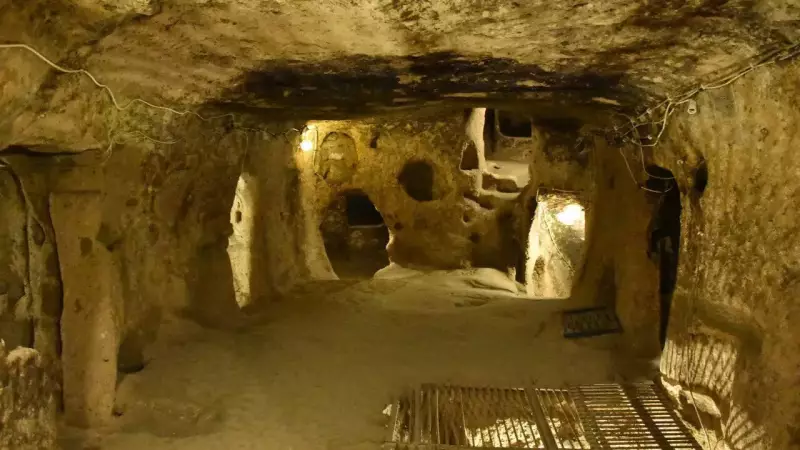
Derinkuyu: Turkey's Ancient Underground City That Housed 20,000 People
Above the ground, Cappadocia presents a surreal, almost alien landscape. Wind-sculpted fairy chimneys rise majestically from dusty valleys, their pale pink and honey-colored rock glowing brilliantly under the intense Turkish sun. At dawn, the sky fills with colorful hot-air balloons drifting serenely overhead, while hikers explore winding paths through canyons shaped by ancient volcanic activity.
The Hidden World Beneath Cappadocia
Yet beneath this dramatic and beautiful terrain lies something even more astonishing. More than 85 meters below the surface, an entire underground city once provided shelter for thousands of people, remaining hidden from view for centuries. This vast subterranean settlement, now known as Derinkuyu, represents one of humanity's most remarkable architectural achievements.
Derinkuyu was not merely a temporary refuge or a simple cave system. It functioned as a fully operational city carved deep into the earth, capable of sustaining life for extended periods, sometimes months at a time. The scale and complexity of this underground metropolis continue to astonish archaeologists and historians alike.

Derinkuyu Underground City: A Buried Metropolis
Derinkuyu stands as the largest excavated underground city in the world. Stretching across an incredible 18 levels, it descends deeper than many modern skyscrapers are tall. An extensive network of tunnels, chambers, and rooms extends for miles beneath Cappadocia, forming a complex underground labyrinth that once housed as many as 20,000 inhabitants.
Originally known as Elengubu, this remarkable city passed through the hands of multiple civilizations throughout history. The Phrygians, Persians, and later Byzantine Christians all contributed to its expansion and adaptation over centuries. Its final chapter concluded in the early 20th century when Cappadocian Greeks fled the region during the Greco-Turkish War, abandoning the underground city almost overnight.
What makes Derinkuyu even more remarkable is the strong suggestion that it was not an isolated phenomenon. Archaeologists believe it may connect to more than 200 smaller underground cities scattered across the region, potentially forming a vast hidden network beneath the Anatolian plains.
Rediscovery After Centuries of Silence
For centuries, Derinkuyu slipped from collective memory, its existence fading into legend. Its remarkable rediscovery in 1963 resulted not from planned archaeological excavation but from a domestic mystery. A local resident, frustrated by chickens repeatedly vanishing into a crack in his home, decided to investigate during renovations. Behind a wall, he uncovered a dark passageway that led to one of more than 600 entrances now known to exist, many concealed within private homes.
Subsequent excavations revealed an astonishing underground world complete with living quarters, food storage areas, stables, chapels, schools, and even wineries. In 1985, recognizing its immense historical significance, Cappadocia and its subterranean cities received designation as a UNESCO World Heritage Site.
Cappadocia's Unique Geological Foundation
Cappadocia's distinctive geology made this extraordinary architectural feat possible. The region's soft volcanic rock, known as tuff, proved easy to carve yet strong enough to maintain structural stability. Combined with dry soil conditions and minimal groundwater, it created ideal conditions for deep excavation using relatively simple tools.
Over millennia, the same volcanic material formed the iconic fairy chimneys visible above ground. Below the surface, it allowed ancient builders to sculpt vast underground chambers with remarkable precision, long before modern engineering techniques existed. The origins of Derinkuyu remain partially uncertain, though some historians credit the Hittites with carving the earliest levels around 1200 BCE while seeking refuge from invading forces. Artefacts discovered within the city support this theory.
However, much of the expansion appears attributed to the Phrygians, an Iron Age civilization renowned for their rock-cut architecture. As empires rose and fell across Anatolia, each successive group adapted the city to meet new needs, transforming it into a layered record of human survival across centuries.

Daily Life and Survival Strategies
Although Derinkuyu likely served storage purposes during peaceful periods, its primary function remained protection. Cappadocia's location at the crossroads of empires made it vulnerable to repeated invasions, and underground living offered crucial safety when surface settlements faced danger.
During the Byzantine era, particularly amid 7th-century raids, Derinkuyu reached its peak development. Narrow corridors forced potential intruders to move single file, while massive circular stone doors could be rolled shut from the inside for defense. Small holes in these doors allowed defenders to strike attackers while remaining protected.
Living underground presented significant challenges. Residents relied on torchlight for illumination, stored waste in sealed clay jars, and designated specific areas for the deceased. Yet the city demonstrated careful organization. Livestock were kept near the surface to manage odors and gases, while deeper levels housed homes, schools, and communal spaces.
Evidence of winemaking, including vats and amphorae, suggests inhabitants prepared for extended stays below ground. A Byzantine missionary school, identified by its distinctive vaulted ceilings, still stands within the maze of tunnels, offering glimpses into the community's spiritual and educational life.
Engineering Marvels: Air and Water Systems
Perhaps the most impressive feature of Derinkuyu is its sophisticated ventilation system. More than 50 shafts circulated fresh air throughout the city, ensuring survival even when all entrances were sealed. A deep well supplied clean water and could be isolated from the surface to prevent contamination during attacks.
These advanced systems indicate that air and water management formed central elements of the city's original design. Without such innovations, sustaining life underground on such a massive scale would have been impossible. Derinkuyu represents the largest known example, but it forms only one piece of a much larger puzzle.
Over 200 underground cities have been discovered across Cappadocia, many connected by tunnels stretching up to 9 kilometers. Some descend three or more levels deep, each equipped with emergency escape routes. In 2014, archaeologists uncovered another massive underground settlement beneath Nevşehir, suggesting Cappadocia's hidden world may still hold many undiscovered secrets.
Derinkuyu's Legacy Today
Derinkuyu's story as an inhabited city concluded in 1923 when its final residents departed. For decades, it lay silent beneath the fairy chimneys, known only to the earth above it. Today, visitors can descend into its narrow passages and experience the unsettling reality of life underground, gaining profound appreciation for ancient engineering and human resilience.
What once served as a place of fear and survival now stands as a powerful testament to human ingenuity. Beneath Cappadocia's breathtaking surface lies a compelling reminder that some of history's greatest architectural achievements were constructed not toward the sky, but deep into the protective embrace of the earth itself.