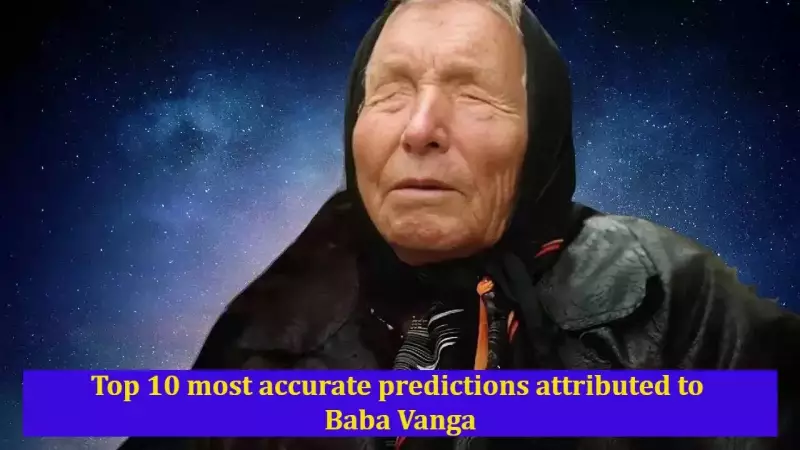
Baba Vanga, the blind Bulgarian mystic who passed away in 1996, remains one of the most enigmatic figures in modern folklore. Often called the 'Nostradamus of the Balkans,' her followers believe she possessed an extraordinary gift of foresight, accurately predicting major global events decades before they unfolded. While skeptics point to a lack of verifiable documentation, the legends surrounding her prophecies continue to captivate audiences worldwide. Here, we delve into ten of her most widely discussed predictions and the historical events they are believed to foreshadow.
The Most Famous Baba Vanga Prophecies
Among the most chilling and frequently cited predictions attributed to Baba Vanga is the September 11, 2001 attacks on the United States. Adherents interpret her alleged statement about "American brethren" falling after an attack by "steel birds" as a direct reference to the passenger planes that struck the World Trade Center. Despite no original written record of this prophecy, it remains a cornerstone of her mythos.
Similarly, the tragic sinking of the Russian submarine Kursk in 2000 is often linked to her words. She is said to have stated, "Kursk will be buried in water, and the whole world will mourn over it." Followers connected this to the disaster in the Barents Sea, which claimed 118 lives, interpreting "Kursk" as the vessel, not the city.

In the realm of politics, many believe Vanga foresaw the election of Barack Obama as the 44th U.S. President. The claim that she predicted an African-American leader gained immense traction following his historic victory in 2008. Another significant political prophecy credited to her is the collapse of the Soviet Union in 1991, interpreted from her vague remarks about the demise of a "great nation" and upheaval in the region.
Disasters, Technology, and Long-Term Visions
Baba Vanga's alleged warnings also extended to technological catastrophes and natural disasters. The 1986 Chernobyl nuclear disaster is frequently matched with her purported prediction of a catastrophic radiation event in Europe. Furthermore, her general warnings about natural calamities are often retrospectively linked to major earthquakes, tsunamis, and cyclones, with some even invoking her name in discussions about potential 2025 disasters.
Interestingly, some interpretations credit her with foreseeing advancements in science and technology, such as lab-grown organs and rapid biotech progress. These connections are drawn from broad, symbolic statements attributed to her after her death.
Her more long-term and speculative predictions venture into space colonization, contact with extraterrestrial life, and apocalyptic scenarios. These visions, stretching centuries into the future, fuel endless debate and curiosity in online forums and among enthusiasts.
Skepticism and Lasting Legacy
It is crucial to note the strong skepticism from experts and critics. There are no proven manuscripts, recordings, or firsthand written accounts from Baba Vanga herself. Most prophecies stem from oral traditions, second-hand sources, and modern media reinterpretations. Critics argue that her statements were intentionally vague and are often retrofitted to match events after they occur—a phenomenon known as postdiction.
Moreover, several bold prophecies tied to her, including predictions of specific large-scale wars, have not materialized. Yet, the enduring fascination with Baba Vanga speaks to a deeper human need. In times of global uncertainty, from political turmoil to pandemics, people seek meaning and solace in the idea that the future might be knowable. Whether viewed as a mystic, a cultural icon, or a piece of modern mythology, Baba Vanga represents humanity's timeless attempt to find patterns and hope in the face of the unknown.