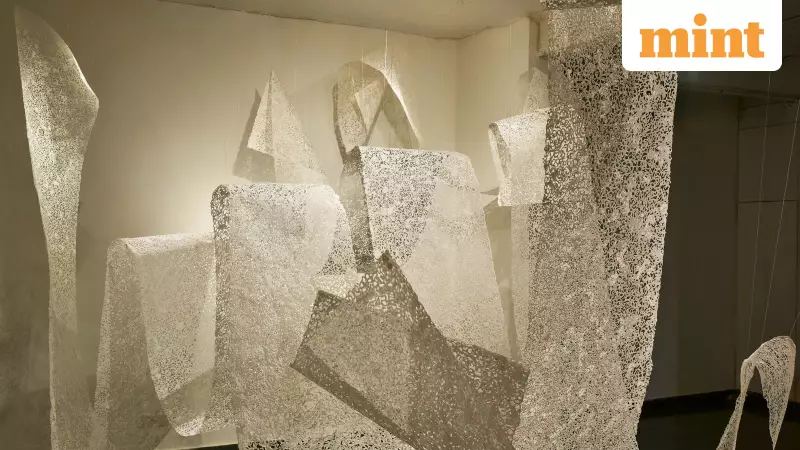
In the heart of Delhi's Gallery Threshold, an arresting vision of suspended, undulating white sheets recently greeted visitors. This large-scale installation, part of the series 'We Don't End At Our Edges', is the work of Bengaluru-based artist Ravikumar Kashi. Crafted from cotton rag fibre pulp, the work is more than a visual spectacle; it is a profound exploration where paper transforms into a vessel for memory, history, and loss.
Paper as a Living Metaphor
For Kashi, paper is never just a passive surface. In his hands, it becomes a sculptural, tactile medium loaded with meaning. His recent solo exhibition, 'Shadows of Breath', which concluded recently, positioned paper as a material that is both fragile and resilient, capable of recording presences and absences. The exhibition's title refers to the fleeting marks and shadows left by the internal rhythms of life itself.
The works on display served as conduits for stories, silences, and conversations. Over the past decade, paper has become central to Kashi's artistic practice. He actively challenges the traditional notions of paper's fragility and passivity through his innovative sculptures and artist books. In his world, paper is not merely a carrier of text; it becomes the text, with its own form, texture, and voice.

The Labour-Intensive Process of Pulp Painting
The creation of these pieces is a meticulous, artisanal process perfected by Kashi over time. In his studio, he combines different plant and textile fibres to create various paper pulps with a sauce-like consistency. Using a nozzle, he writes text directly onto a plastic sheet. As the pulp dries, it acquires intricate textural forms.
"It took me a long time to arrive at the right consistency," admits Kashi. "But when I did, it opened up immense artistic possibilities for me." This labor-intensive method adds a deep layer of meaning to the work, as the idea evolves with each step, mirroring the artist's internal state. For instance, creating a single 32-foot scroll for a large white work took him 12 hours for just half of it, with thoughts and visual ideas flowing in waves during the process.
Language, Cityscapes, and Future Exhibitions
Kashi's engagement with text is longstanding, informed by his work as an author and lecturer in both Kannada and English. In his art, language becomes a membrane that holds memory. One powerful work features an off-white surface crisscrossed with earthy red veins, resembling a human heart's topography from afar. Up close, it transforms into a map of Bengaluru, crafted from Daphne fibre pulp, with the veins mimicking the city's streets. Kannada text from poet Gopal Krishna Adiga's hopeful post-independence verses is integrated into the piece.
The exhibition journey ended with 'Where the Words Bloom', where alphabet tendrils stream from the ceiling, metaphorizing language as a living, blooming entity inspired by Bengaluru's vibrant spring colours.
Art enthusiasts will get another chance to experience Kashi's monumental work soon. He will be presenting a new large-scale installation titled 'Holding Pattern' at the Bangalore International Centre. This nearly 13-foot-tall rotating work will be featured as part of the BLR Kala Hubba from 16-25 January 2026. This installation promises to continue his exploration of paper as a dynamic medium for capturing the ephemeral shadows of breath and being.