In the dense, choking smog of our cities and within the relentless grind of our daily routines, a haunting parallel to an ancient Greek punishment has emerged. We have collectively become the modern Sisyphus, condemned to push our boulders up the hill in a cycle of silent, profound absurdity.
The Myth and Our Dystopian Reality
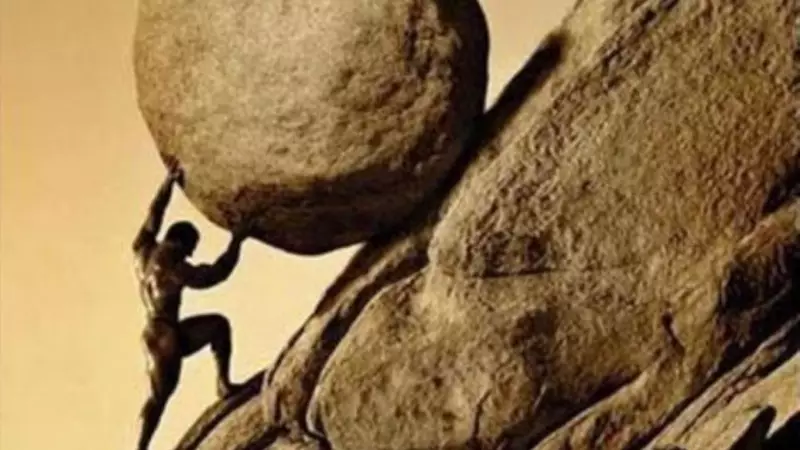
In Greek mythology, King Sisyphus was punished in the underworld for his deceit. His eternal task was to push a massive boulder up a mountain, only to watch it roll back down each time he neared the summit, forcing him to begin again—forever. This myth found powerful philosophical resonance in the 20th century through the work of Albert Camus, who used it to illustrate the human confrontation with the absurd.
Today, this framework feels chillingly relevant. One needs only to look at Delhi, periodically engulfed in a dystopian atmospheric haze, to see the myth made real. The most objectionable fact is not merely the poisonous air itself, but the collective veil of ignorance worn as citizens breathe it, normalizing a deeply abnormal state of existence. The belief that ‘we shall become immune,’ rather than taking concerted action to eradicate the root cause, leads directly to the fundamental question Camus posed about the value of life.

The Mundane Rhythm and the Arising "Why"
Camus began his seminal essay, The Myth of Sisyphus, with a startling proposition: “There is but one truly serious philosophical problem, and that is suicide.” He grounded this in the crushing mundanity of everyday existence: “Rising, streetcar, four hours in the office or the factory, meal, streetcar, four hours of work, meal, sleep...”
He noted that this rhythm is easily followed, until one day the “why” arises. In our modern Indian metropolitan landscapes, we are surrounded by blank faces locked in this endless cycle of tiredness, unfulfillment, and quiet complaint. This existence, Camus would argue, is not superior to Sisyphus’s fate; it is its direct parallel. We wake for our eight-to-ten-hour jobs, we follow the course, we push forward. But for what ultimate purpose, especially when we exist in a palpable dystopia, able to see the very air that harms us?
Hope as the Shield of Ignorance
Camus pinpointed a simple, four-letter word that fuels this cycle: hope. We live in a constant state of it. Believing we will wake tomorrow is hope. Believing our tasks hold inherent meaning is hope. However, Camus argued that this collective hope paves a path to a profound and dangerous ignorance.
We are so tuned into hope, so certain of a future that has not yet happened, that this hope becomes an imaginary shield. It allows us to neglect fundamental human needs, to passively witness environmental degradation, and to remain indifferent to collapsing social structures. This hopeful ignorance is the bedrock of what Camus termed “the absurd”—the confrontation between the human need for meaning and the universe’s unreasonable silence.
Our hopeful belief in a better future fosters an ignorance that lets us ignore a present catastrophe. The universe provides no rational answers to our cries for justice or clean air; it offers only silence. It is often easier to exist within this silence than to constantly rage against it.
The Defiant Question for Our Time
This brings us to Camus’s final, defiant question: “Do we then imagine Sisyphus to be happy?” Or, in our modern context, do we find him to be ignorant? Is his perpetual push of the boulder a demonstration of our own hollow hopefulness for a different outcome to an inevitable cycle?
We push our own boulders—our careers, routines, and responsibilities—up the hill, hoping for a summit that offers a permanent view, only to watch them roll down again. We hope the air will clear, that the system will change, that our efforts will finally matter, all while ignoring the inherent, crushing inevitability of the cycle itself.

As we adjust our masks and glance at the smog-choked horizon of our cities, the happiness of Sisyphus is no longer just a philosophical curiosity. It is the essential question of our time. Are we lucidly aware of our absurd struggle, finding meaning in the struggle itself as Camus suggested? Or are we merely hoping, ignorantly, for a different result from the same eternal task? In the silent, polluted air of modern India, this is a question worth pondering.