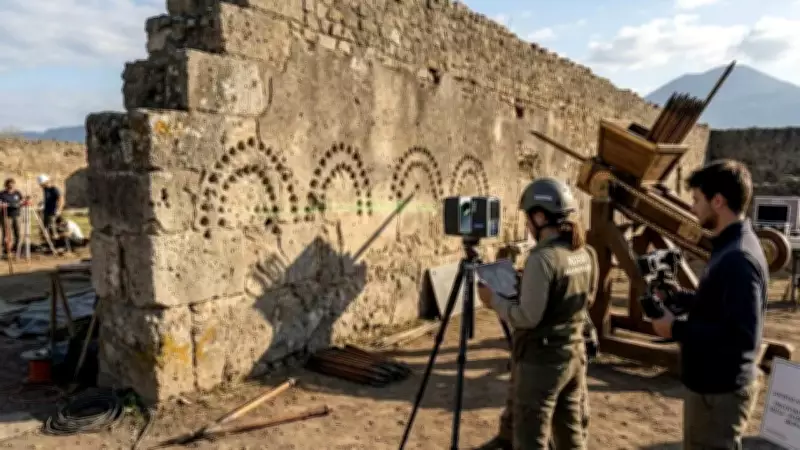
High-Tech Scans Reveal Ancient 'Machine Gun' Used in Pompeii Siege
While the catastrophic eruption of Mount Vesuvius in AD 79 has long dominated archaeological studies of Pompeii, groundbreaking new research has uncovered evidence of a violent conflict nearly 170 years earlier. Using state-of-the-art laser scanning and 3D digital imaging techniques, a team led by researcher Adriana Rossi has identified unique ballistic signatures on the northern fortification walls of the ancient city.
Evidence of a Revolutionary Ancient Weapon
According to research published in MDPI, these distinctive impact patterns suggest the use of the polybolos—a multiple-shot repeating catapult often described as the ancient equivalent of a machine gun. This discovery shifts our understanding of the siege of Pompeii during the Social War in 89 BCE, when Roman General Lucius Cornelius Sulla attacked the city.
The evidence for this ancient weapon doesn't come from physical artifacts but rather from what researchers call 'ballistic scars' on Pompeii's limestone walls. Unlike the large, separate craters created by standard heavy catapults, these impact marks appear in curved, tightly clustered formations. This pattern indicates projectiles were fired from a stationary position, with recoil or manual corrections creating straight lines of fire.

The Polybolos: Ancient Engineering Marvel
The polybolos represented a revolutionary advancement in siege warfare technology. Created in the third century BC by Philo of Byzantium, this device differed fundamentally from traditional ballistae. Rather than requiring manual tensioning for each shot, the polybolos could continuously reload and fire until its magazine was exhausted.
This ancient weapon utilized a flat-link chain mechanism—considered the earliest known use of such technology in the world—connected to a windlass. With a single motion, the operator could turn the windlass while simultaneously drawing the bowstring, loading another bolt from a gravity-fed tray, and releasing the firing mechanism.
The design allowed one battery of polybolos to effectively suppress defenders on city walls and clear defensive positions with a rapid stream of projectiles. Researchers believe General Sulla likely acquired this technology through his campaigns in the Eastern Mediterranean, giving him a decisive advantage against Pompeian defenders.
How Technology Uncovered Ancient Warfare
The research team employed high-resolution LiDAR (Light Detection and Ranging) and digital photogrammetry to distinguish artillery damage from natural erosion. By creating an extremely dense three-dimensional LiDAR point cloud of the wall surface, researchers could measure the depth, diameter, and trajectory of each impact hole with unprecedented precision.
The polybolos impacts showed remarkable uniformity, suggesting they were fired from the same mechanically consistent machine rather than by different human operators. This consistency points to advanced manufacturing and operation standards in ancient Roman warfare.
The pattern of artillery marks indicates the polybolos were likely fired from elevated wooden towers designed to target defenders from above. This explains the concentration of impact clusters at high elevation points along Pompeii's northern fortifications, where defenders would have been most vulnerable to such attacks.
Broader Implications for Archaeological Understanding
This discovery not only reveals specific details about the siege of Pompeii but also demonstrates how advanced Hellenistic engineering influenced Roman military tactics. The research, titled 'From Pompeii to Rhodes, from Survey to Sources: The Use of Polybolos,' connects ballistic evidence with historical accounts to create a more complete picture of ancient warfare.
The use of such sophisticated technology in 89 BCE suggests Roman military forces had access to and effectively deployed advanced siege weapons much earlier than previously understood. This finding challenges traditional timelines of military technological development in the ancient world.
As archaeological techniques continue to advance, similar discoveries may reshape our understanding of other historical conflicts and technological transfers between ancient civilizations.