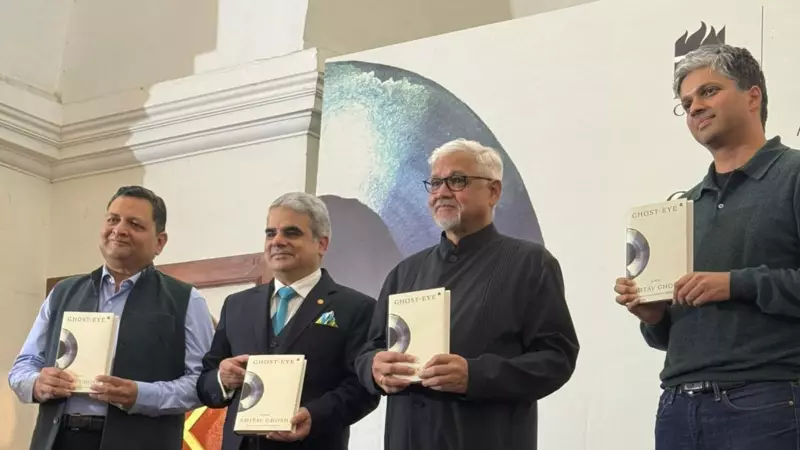
Celebrated author Amitav Ghosh unveiled his latest literary offering, 'Ghost Eye', at a poignant event in the capital on January 6. The launch, held at the recently restored Ambassador Hotel near Khan Market, was steeped in personal nostalgia for Ghosh, who spoke fondly of the venue's connection to his years in Delhi.
The Genesis of 'Ghost Eye' and the Power of Past Lives
In a candid conversation with writer Keshava Guha, Ghosh revealed the unusual and swift genesis of his first novel in several years, published by Harper Collins. "It just came to me and I just wrote it. It just wrote itself, really," he confessed, likening the experience to Stephen King's description of ideas arriving from an external agency. This framing is apt for a narrative that treats reincarnation as a lived disturbance rather than a mere metaphor.
The story is anchored in 1969 Kolkata, where a three-year-old girl from a staunchly vegetarian family suddenly demands fish. Ghosh explained this pivotal moment is inspired by his research into documented cases of reincarnation, many from India. He was particularly fascinated by how such memories are often tied to appetite. "There are innumerable cases of... children with past life memories who are absolutely haunted by the desire to eat from their past lives," Ghosh noted.

Food, Ecology, and the Limits of Modern Knowledge
The theme of food evolved into a central motif of the discussion. Ghosh cheerfully admitted, "Food is frankly a very large part of my life," connecting it to cooking, markets, and the deep knowledge they hold. He argued that markets reveal as much about ecology as they do about the economy. While expressing respect for science, Ghosh cautioned against its dominance as the sole language for understanding nature. He pointed out that ordinary fishermen and women often possess more nuanced environmental knowledge than credentialed experts.
This skepticism is deeply influenced by Ghosh's relationship with Kolkata, a city that runs "in the opposite direction from the rest of the world" and taught him "to be sceptical about the claims of modernity." Writing 'Ghost Eye' became a process of reliving his childhood there, and this perspective fuels the novel's larger anxieties about ecological collapse, extractivism, and contemporary thinking.
Seeing Differently: Literature Beyond Scientific Frames
When asked about climate fiction, Ghosh expressed discomfort with reducing complex crises to a single genre label. "Science is a way of knowing the world and like all ways of knowing the world, it has its limitations," he stated. He championed literature's role in opening imaginative possibilities rather than replicating scientific constraints. In a simple yet powerful summation, Ghosh gestured to the book's title, stating the novel is ultimately about learning to see differently.
The event was also attended by Udayan Mitra, Executive Publisher at Harper Collins, and Mandeep Surie, General Manager of The Indian Hotels Company Limited (IHCL). The restored Ambassador Hotel, a once-bustling landmark, served as a fitting backdrop for a novel deeply concerned with return, restoration, and the haunting power of memory.