A Complete 28-State Saree Guide of India: From Kanjeevaram to Bandhani
We often overlook the incredible treasure trove of textiles nestled right in our wardrobes. The Indian handloom landscape is far more than mere fabric; it is a vibrant tapestry woven with history, geography, and artistic expression. From the heavy, opulent silks that demand impeccable posture to the breezy, earthy cottons designed to endure an Indian summer, every state in India narrates a unique sartorial story. To truly comprehend India, one must gaze upon its looms. Here is your comprehensive, state-by-state exploration of the nation's most iconic drapes.
The Northern Charm and Himalayan Threads
In the northern regions, textiles beautifully merge royal heritage with mountain practicality. Uttar Pradesh presents the Banarasi saree, heavily brocaded with gold and silver floral jaals that instantly command attention in any setting. In contrast, Punjab offers the loud and joyous Phulkari, a vibrant canvas adorned with intricate floral embroidery. Haryana maintains comfort and celebration with the Resham Dhuria, blending silk embroidery on soft cotton fabric. Venturing into the Himalayas, Himachal Pradesh showcases Kullu Patti sarees, featuring vivid geometric shawl borders against wool or cotton, while Uttarakhand provides Panchachuli weaves, offering fine, understated elegance crafted by the women of the mountains.
Eastern Epics and Northeastern Magic
The eastern part of India is renowned for storytelling and raw texture. West Bengal contributes the Baluchari saree, a literal wearable epic with pallus depicting entire scenes from the Ramayana or Mahabharata. Bihar introduces the eco-friendly Bhagalpuri Tussar, boasting a rustic finish that transitions seamlessly from a bustling newsroom to an elegant dinner. Similarly, Jharkhand offers Tribal Tussar, and Odisha presents the hazy, tie-dyed Sambalpuri Ikat, both deeply rooted in natural motifs. The Northeast is a treasure trove of sustainable, intricate artistry. Assam is famous for its golden Muga Silk, which miraculously grows glossier with each wash. Meghalaya provides thermal-regulating Eri Silk, also known as peace silk, offering a gorgeous matte finish, while Arunachal Pradesh features Apatani weaves and Sikkim showcases Lepcha sarees, bringing earthy, minimalist tribal stripes to contemporary wardrobes. Additionally, Nagaland displays breathtaking geometric clan patterns in Naga Motif drapes, Mizoram offers tight weaves and bold stripes in Puan-inspired sarees, and Tripura presents distinct tribal flashes in Risa-inspired fabrics. Finally, Manipur stands out with the sheer cotton Moirang Phee, distinguished by delicate, temple-like edge motifs.

The Western Wonders and Central Heart
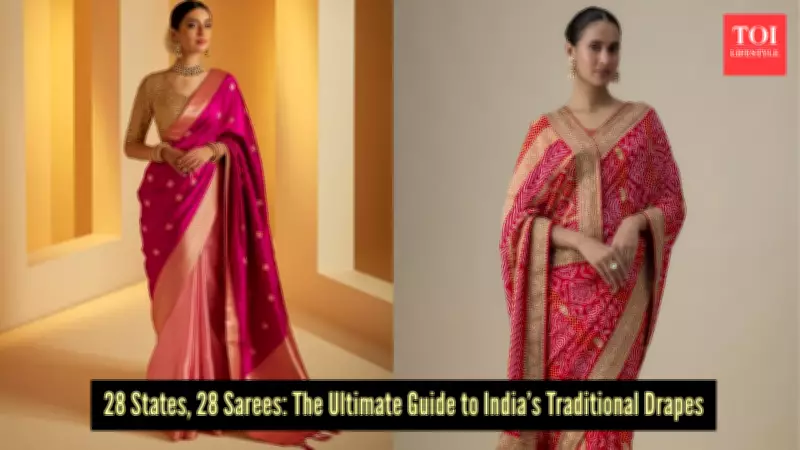
Western India excels in dyeing techniques. Rajasthan brings the desert to life with classic Bandhani, characterized by hyper-saturated, fluid tie-dye patterns. Gujarat offers the mathematically precise Patola, a double-ikat masterpiece that requires months to perfect. In Maharashtra, the luxurious silk Paithani reigns supreme with its signature peacock pallus. Goa counters this royal flair with the Kunbi saree, a highly breathable, red-checked cotton drape that revives coastal tribal heritage. In central India, Madhya Pradesh provides the feather-light, translucent Chanderi, an ultimate summer savior. Neighboring Chhattisgarh offers Kosa Silk, a beautiful, coarse matte alternative adorned with tribal art.

Southern Splendor
Southern India showcases architectural weaves. Tamil Nadu presents the Kanjeevaram, the heavyweight champion of Indian textiles, made from pure mulberry silk and rich zari temple borders. Kerala goes the opposite route with the Kasavu, the epitome of soft elegance featuring crisp white cotton edged in radiant gold. Karnataka contributes the Ilkal saree, instantly recognizable by its striking red "tope teni" pallu. Andhra Pradesh delivers the delicate Uppada Jamdani, a zari marvel that breathes beautifully, while Telangana completes the map with the Pochampally Ikat, famous for its impossibly smooth silk-cotton blend and sharp geometric precision.