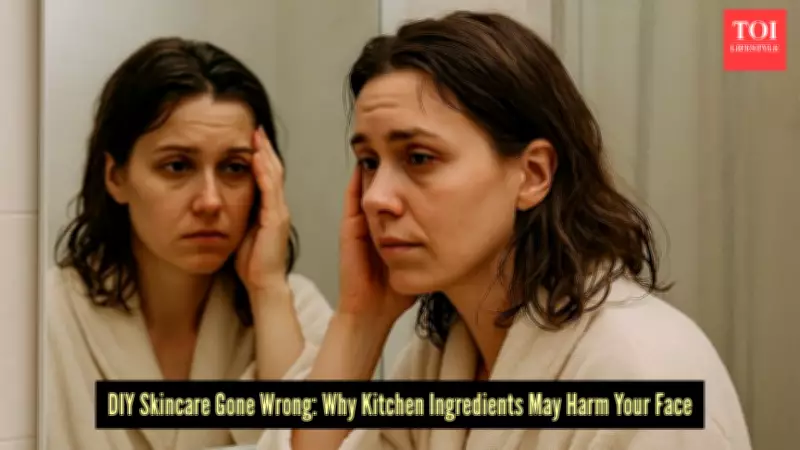
The Hidden Dangers of DIY Skincare: Why Your Kitchen Is Not a Beauty Lab
In today's digital age, a troubling paradox has emerged in beauty routines worldwide. While we demand rigorous scientific validation for medications, many eagerly follow 15-second social media reels advocating raw pantry staples as skincare miracles. The internet has successfully branded "chemical" as a dirty word while promoting "natural" as a universal safety guarantee. However, dermatologists warn that this trend is causing significant skin damage. Natural does not equate to safe, and your late-night DIY skincare experiments might be precisely why your skin barrier is compromised. Let's examine the scientific realities behind these dangerous trends and why you should stop treating your face like a culinary experiment.
The Acidic Assault of Lemon Juice
One of the most persistent myths involves using raw lemon juice to brighten dark spots. Here's the harsh truth: while your skin thrives in a slightly acidic environment with a pH around 5, lemon juice operates at a battery-acid-adjacent pH of 2. Applying it doesn't enhance your complexion; it induces localized chemical burns. Furthermore, lemons contain psoralens, compounds that trigger phototoxic reactions. Exposure to sunlight after a DIY lemon mask can cause phytophotodermatitis, resulting in severe blistering and inflammation. For individuals with melanin-rich Indian skin tones, this so-called "glow hack" often leaves stubborn dark marks that require months to fade, creating more problems than it solves.
Baking Soda: The Alkaline Barrier Destroyer
If lemon represents acidic damage, baking soda embodies alkaline destruction. With a pH of 9, baking soda is aggressively basic. Online forums frequently promote it as a miracle exfoliator, but using it actively dismantles your skin's protective acid mantle. Forcefully elevating your skin's pH strips away essential lipids, leaving your face vulnerable. The aftermath transforms your complexion into a breeding ground for acne-causing bacteria. Rather than drying out pimples, you're damaging the structural integrity of surrounding tissue, inviting chronic dryness and triggering rebound oil production that exacerbates skin issues.

Essential Oils and the "Natural" Allergy Trap
The practice of applying neat tea tree oil or lavender water directly to the skin seems harmless because these products smell luxurious. However, essential oils are highly volatile, hyper-concentrated plant chemicals. Dermatologists report increasing cases of Allergic Contact Dermatitis from such usage. Compounds like linalool can trigger severe, compounding sensitization over time. You might escape immediate reactions initially, but eventually, your immune system may launch a full-scale attack, resulting in weeping, itchy rashes. Remember this crucial point: poison ivy is completely natural too, yet nobody would consider it safe for skincare.
The Micro-Tear Menace of Physical Exfoliants
Kitchen staples like sugar and coffee grounds are often recommended as physical exfoliants, but they pose significant risks. Facial skin is incredibly delicate and requires controlled exfoliation, which is why dermatologists prefer gentle chemical acids. Under microscopic examination, sugar crystals and coffee grounds resemble jagged glass shards. Vigorously scrubbing these abrasive particles into your pores creates microscopic tears across the epidermis. This isn't proper exfoliation; it's trauma. Your skin rapidly loses moisture, becoming severely dehydrated and vulnerable to premature aging. Reserve granular scrubs for tougher areas like elbows, not your sensitive facial skin.

Your Face Is Not a Biological Experiment
Finally, the danger extends to "fresh" concoctions like egg white masks or blended oat mixtures. Commercial skincare products incorporate broad-spectrum preservatives for a critical reason: to prevent microbial growth. Raw egg whites carry genuine risks of topical Salmonella contamination. That homemade oatmeal-milk paste sitting on your vanity? Without preservatives, it transforms into a hazardous biological experiment within 48 hours. Applying spoiled, bacteria-laden food to compromised skin barriers invites fungal infections and cystic breakouts. The fundamental lesson is clear: your kitchen pantry is designed for cooking, not chemistry. When viral videos suggest creating facial salads, save those ingredients for consumption instead of application.