

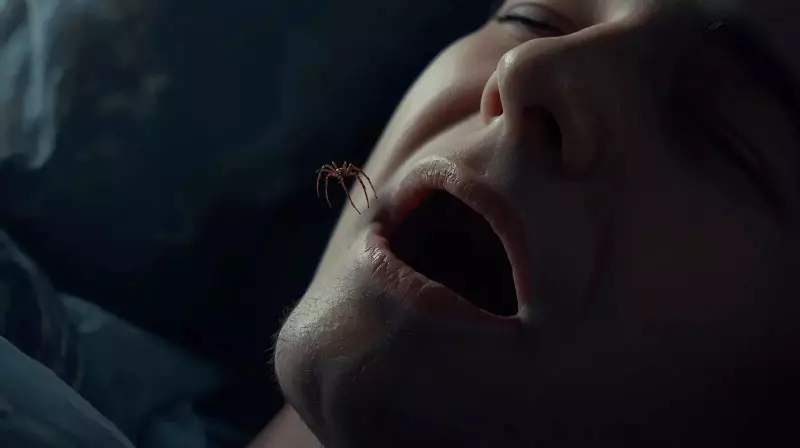
Have you ever heard the unsettling claim that you swallow eight spiders a year in your sleep? This bizarre factoid often surfaces in late-night conversations, presented as a chilling truth. It feels just believable enough to send a shiver down your spine. However, this widely accepted 'fact' is a complete fabrication, a classic example of how misinformation spreads and hardens into false belief.
The Origin of the Eight Spiders Myth
According to authoritative sources like Britannica, no scientific study has ever documented people swallowing spiders during sleep. The specific number—eight spiders per year—has no credible source. It did not originate from any research paper or controlled experiment. Most researchers trace its roots to the early days of the internet, where it was circulated as a social experiment to demonstrate how easily false information could travel when repeated often enough.
Once the idea took hold, it gained momentum through repetition in magazines, classrooms, and casual chats. The vivid and disturbing imagery made it memorable, but repetition alone does not create truth. Entomologists and scientists have been clear for years: this is a myth. When questioned, their answers are typically brief and definitive: it does not happen, or if it does, it is an event so rare it cannot be measured.

Why Spiders Actively Avoid Sleeping Humans
From a spider's perspective, a sleeping human is a terrifying landscape. We are massive, unpredictable, and noisy creatures. Even in slumber, our bodies generate constant vibrations from breathing and heartbeat. Spiders are exquisitely sensitive to these vibrations. To them, a sleeping person feels like unstable, dangerous ground.
Spiders prefer still, quiet spaces where they can detect threats from a distance. A human face, with its warm, rushing breath, offers no such safety. Most spiders would actively avoid it, choosing walls, corners, or undisturbed surfaces instead. They are not curious adventurers; they are cautious survivors focused on finding food and avoiding predators.
The Improbability of a Spider Crawling Into Your Mouth
Experts stop short of calling it utterly impossible—in theory, almost anything can happen. But the probability is astronomically low. For a spider to crawl onto a face, ignore the powerful vibrations, and then proceed into an open mouth without triggering a reflex would require a perfect, unlikely chain of events.
Furthermore, our bodies are wired to detect light touch, especially around the mouth and nose. The sensation of eight tiny legs moving across your face would most likely wake you up. So, while the idea makes for a compelling horror story, it contradicts both human biology and spider behaviour.
The Real Role of Spiders in Our Homes
Only a small fraction of spider species coexist with humans indoors. Most of these are reclusive, building webs in low-traffic areas like corners, basements, attics, or behind furniture. Spiders do not roam houses looking for people; they are hunting insects like flies, mosquitoes, and other pests.
In this way, they provide a helpful, silent pest control service. Entomologists often advise leaving spiders alone unless they pose a direct problem or cause severe anxiety. Their presence is typically a sign of a healthy, insect-managing ecosystem within your home.
Why This Creepy Myth Refuses to Die
The spider-swallowing myth persists because it taps into deep-seated human discomfort. It combines elements of sleep (a vulnerable state), loss of control, and a common fear (arachnophobia). These ingredients create a perfect, sticky myth. However, once you examine the actual behaviour of spiders, the fear unravels. They are not lurking predators but shy creatures seeking safety.
The truth—that spiders avoid us—is mundane, which is why it struggles to capture the imagination like the myth does. The enduring power of this false fact says more about how stories travel online than about how spiders behave in reality, and that might be the most revealing part of the tale.






