

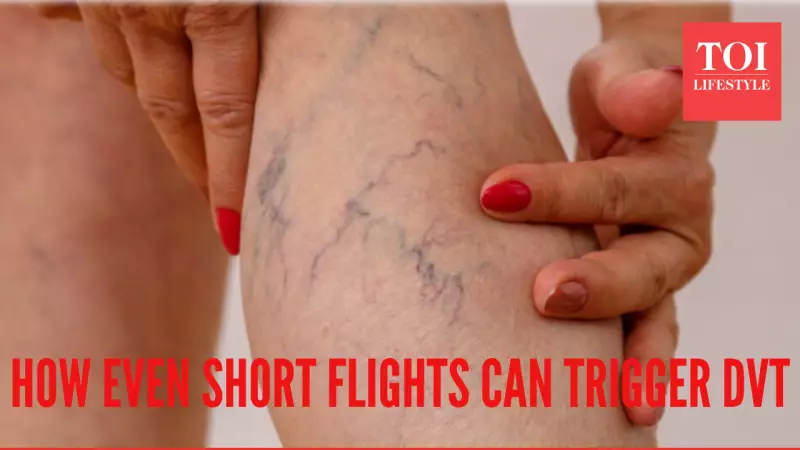
A recent social media post has sent a stark warning to air travellers. A woman shared on Instagram that she suffered severe leg cramps following a brief one-hour flight. The situation escalated rapidly, leading to a hospital stay where she was diagnosed with dangerous blood clots in her legs and lungs. While such severe cases are rare, this incident highlights a hidden health risk associated with air travel, even on short journeys.
Understanding Deep Vein Thrombosis (DVT) and Its Dangers
Deep vein thrombosis (DVT) occurs when a blood clot forms in a deep vein, typically in the legs. Symptoms can include pain, swelling, redness, and warmth in the calf or thigh, though some individuals show no signs at all. The real danger emerges if a part of the clot breaks off and travels to the lungs, causing a pulmonary embolism (PE). This condition can lead to breathing difficulties, chest pain, coughing up blood, and can be fatal in severe cases.
Dr. Kunal Sood, MD, explains that while risk increases with age, DVT can affect people of all ages, including those under thirty. Diagnosis often involves ultrasound imaging and D-dimer blood tests. Early treatment with blood thinners like heparin is crucial to prevent the clot from growing and to stop a PE from developing.

Why Flying, Even Briefly, Increases Clot Risk
The unique environment of an airplane cabin creates a perfect storm for clot formation, a concept known as Virchow's triad. Cabin pressure decreases can cause mild dehydration, thickening the blood. Reduced oxygen levels may increase clotting factors. Most significantly, cramped seating restricts movement, slowing blood flow in the legs. Research shows blood flow through the popliteal vein can decrease by 40% when seated immobile.
Contrary to old beliefs, short flights lasting more than four hours carry a measurable risk. A large study of frequent flyers found 3.2 cases of venous thromboembolism (VTE) per 1,000 person-years within eight weeks of flights over four hours, compared to 1.0 case without such travel. The risk rises by about 26% for every additional two hours of air travel beyond four hours. The danger peaks during the second week post-flight and usually disappears by the eighth week.
The absolute risk remains low, at less than 1 case per 4,500-4,600 flights. However, with millions flying annually, the total number of affected individuals becomes significant. Repeated travel, common among business flyers, cumulatively increases exposure.
Who is at Higher Risk and How to Prevent DVT
Certain factors substantially increase susceptibility. These include:
- Use of oral contraceptives or hormone therapy (triples the risk).
- Obesity (BMI over 25).
- A previous history of DVT, cancer, recent surgery, pregnancy, or smoking.
- Having varicose veins or a family history of blood clots (doubles the risk).
- Taking multiple flights (risk increases 1.4 times per additional flight).
For most low-risk travellers, medication is not necessary. Effective prevention strategies are simple:
- Stay hydrated: Drink plenty of water and avoid alcohol and caffeine.
- Move regularly: Get up and walk the aisle every hour. Perform calf raises, ankle circles, and knee lifts every 30 minutes while seated.
- Choose an aisle seat for easier movement and wear loose clothing.
- Consider compression stockings: Graduated compression stockings (15-30 mmHg below-knee) have been shown to reduce asymptomatic DVT risk by 90%.
For high-risk individuals, consulting a doctor for guidance on blood thinners may be advised, though evidence is limited. Major health societies recommend compression stockings over medication for most people. Starting hydration and calf exercises a day before travel yields the best protective results.
The key takeaway is awareness. While the odds are in your favour, understanding the risk factors and taking proactive, simple steps during any flight longer than a few hours can be a vital safeguard for your health.






