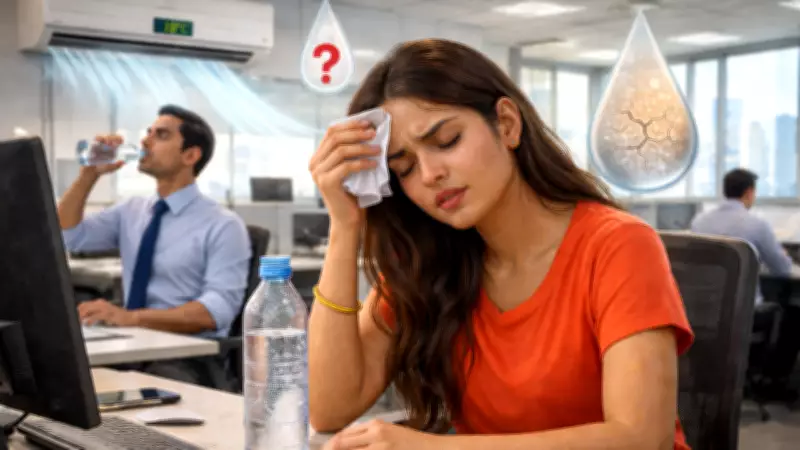
Office Workers Face Higher Dehydration Risk Than Outdoor Laborers, Expert Warns
At first glance, it seems counterintuitive. The construction worker laboring under scorching 40-degree heat, the delivery rider navigating midday traffic, the vegetable vendor who hasn't rested since dawn—these individuals appear most vulnerable to dehydration. Yet, medical evidence reveals a surprising pattern: the person sitting comfortably in an air-conditioned office with a water bottle on their desk often ends up in worse hydration status by day's end.
Dr. P. Vikranth Reddy, Clinical Director and Senior Consultant in Nephrology at CARE Hospitals, Banjara Hills, Hyderabad, has observed this phenomenon repeatedly in clinical practice. "Initially, it seems obvious that people working outdoors in sunlight would be more prone to dehydration than indoor workers," he states. "However, that isn't always what manifests in reality. Frequently, office employees in temperature-controlled environments consume far less water than their bodies actually require."
When Comfort Masks Dehydration Signals
The human body possesses a reasonably reliable dehydration alarm system: thirst. However, thirst functions as a gentle nudge rather than a loud alarm. This nudge operates most effectively when reinforced by external factors like heat, visible perspiration, or the general discomfort of outdoor summer conditions. Remove these environmental cues, and the thirst signal becomes remarkably easy to ignore.

Air conditioning creates precisely this scenario. The environment feels comfortable—no sweating, no flushed skin, no heat-induced dry throat. Consequently, the body's natural signals become dampened. Hours pass unnoticed, dehydration accumulates silently, and nobody recognizes the developing deficit.
Dr. Reddy clarifies this critical point: "Cool air feels pleasant, but it can be surprisingly drying. Fluid loss continues through skin evaporation and respiration, just without visible sweating. Because nothing feels extreme, hydration doesn't seem urgent. Throughout the day, this gap gradually widens."
Thus, the individual seated beneath an AC vent all day loses water through skin and breath—just not in a perceptible manner. With no discomfort to highlight the issue, nothing prompts compensatory drinking.
The Caffeine Consumption Trap
Walk through any Indian office between 9 AM and 6 PM, and you'll witness a familiar pattern: tea rounds, coffee machines, vending machines. Caffeine integrates seamlessly into the workday rhythm—it's social, habitual, and addresses the afternoon energy slump. The problem emerges when caffeine beverages quietly substitute for water.
Dr. Reddy explains plainly: "Tea and coffee frequently fill hydration gaps. They contribute some fluid but typically replace water rather than supplement it. Many individuals consume multiple caffeine servings yet still fall short on genuine hydration. By day's end, intake appears adequate but isn't equivalent."
This aspect catches people unexpectedly. They feel they've been drinking beverages all day—multiple chai cups, post-lunch coffee, perhaps an afternoon cold drink. It doesn't register as underhydration. However, when actually calculated, the tally often proves insufficient.
Symptoms Commonly Misattributed to Other Causes
Here, office worker dehydration becomes particularly insidious. It doesn't announce itself dramatically like post-exercise or beach-day dehydration. Instead, it manifests through mundane symptoms—a slight afternoon headache, diminished concentration around 4 PM, fatigue seemingly attributable to workload rather than physiological need.
"Mild dehydration doesn't feel dramatic," notes Dr. Reddy. "It tends to appear subtly: slight tiredness, dull headache, or concentration difficulties. These symptoms easily get blamed on workload, screen time, or sleep deprivation. Hydration rarely springs to mind first. Sometimes, even dry lips or mild head heaviness gets ignored and dismissed as normal workday experience."
This final point warrants reflection. Society has collectively decided that afternoon fatigue and low-grade headaches constitute inherent work experiences. They don't always. Sometimes the body simply requests water, and we fail to listen.

How Sedentary Behavior Affects Bodily Cues
Another easily overlooked layer exists. Movement assists hydration awareness—not merely for circulation or metabolism, but for noticing bodily signals. When you rise, walk somewhere, or shift physical context, you're more likely to recognize thirst, dry mouth, or extended periods without drinking. Prolonged sitting, especially when screen-focused, diminishes these opportunities.
Dr. Reddy observes: "Remaining in one location for extended periods reduces chances of noticing bodily cues. Less frequent movement also means fewer opportunities to reach for water. Over time, this establishes a pattern—long hours pass with minimal intake. Even when water sits nearby, it may not get consumed as expected."
The unfinished water bottle on the desk, the corner dispenser nobody visits without reason, the 90-minute back-to-back meeting stretch where nobody refills glasses—these small gaps compound significantly.
Long-Term Consequences: What Kidneys Eventually Reveal
Most dehydration registers as inconvenience—occasional headaches, sluggish afternoons. However, Dr. Reddy brings a nephrologist's perspective to sustained underhydration's effects over months and years. "From a medical viewpoint, consistently low fluid intake doesn't remain consequence-free," he cautions. "Urine becomes more concentrated, and over time, kidney stone or urinary infection risks increase. These aren't immediate effects, which explains why they're often disconnected from daily habits initially. By symptom appearance, the pattern usually has existed for considerable duration."
The Solution Isn't Complicated
Dr. Reddy doesn't prescribe dramatic overhauls. The remedy proves genuinely simple, requiring only intentionality. "Keeping water nearby, taking brief breaks between tasks, and not relying exclusively on tea or coffee can help. Even regular water sipping throughout the day makes a difference," he advises. "Ultimately, environment alone doesn't determine hydration. How the day structures around hydration matters most. Once recognized, the fix typically becomes straightforward."
Practical measures include:
- Keeping water bottles on desks rather than in bags
- Setting hydration reminders if necessary
- Rising briefly between meetings
- Recognizing that not every chai cup counts as proper hydration
Offices won't become less air-conditioned. However, occupants can choose to pay closer attention to what their bodies quietly request, even when those requests aren't loud.