

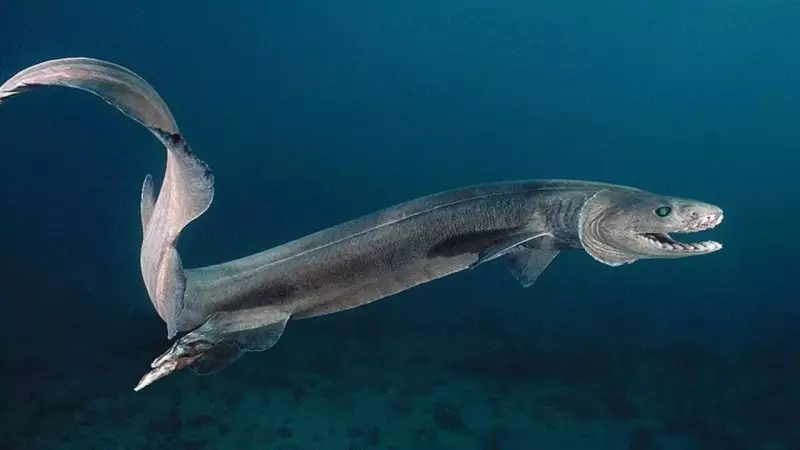
The mysterious depths of the world's oceans hide creatures so strange they seem alien. For centuries, many of these deep-sea dwellers have successfully avoided human discovery. Among the most fascinating is the frilled shark, scientifically known as Chlamydoselachus anguineus. Often called a 'living fossil,' this species has been known to science for over a century, yet its life cycle, breeding habits, and feeding patterns remain largely a mystery. Rarely caught in fishing nets, the frilled shark offers scientists a priceless window into evolution, demonstrating how life can persist, virtually unchanged, for tens of millions of years in the light-starved, hostile deep sea.
The Eel-Like Anatomy of a Prehistoric Shark
At first glance, the frilled shark looks more like a serpent or an eel than a typical shark. It has an elongated, cylindrical body that can reach an average length of two metres (6.5 feet). Its skin texture is simple to maintain, and it has small fins, with the dorsal fin positioned unusually close to the tail rather than the centre of the body.
The most striking features, however, are its head and gills. Unlike most sharks, the frilled shark possesses six gill slits. Each gill has a distinctive frilled edge, giving the species its common name. These gills are connected in a unique way, forming a collar-like ruffle under the throat. This design is not just for show; it is a highly efficient adaptation for extracting oxygen from the deep, cold water.

Its head is dominated by a wide mouth lined with rows of sharp, trident-shaped teeth. This formidable jaw can bend to allow the shark to swallow large squids and small fish whole—a feeding method uncommon among other shark species.
Deep-Sea Hunter: Stealth Over Speed
The frilled shark is a top predator in the dark abyss. Studies of its stomach contents reveal a diet consisting mainly of squid, but it also devours smaller fish and even other sharks. Its needle-like teeth are perfectly crafted for gripping slippery, soft-bodied prey.
Instead of relying on the high-speed bursts common in surface sharks, the frilled shark is a master of stealth. Its snake-like, flexible body allows it to navigate effortlessly through narrow crevices in rocks and coral formations, ambushing prey with precision. This hunting strategy is a remarkable example of evolutionary adaptation to a deep-sea environment where energy conservation is key.
A Slow Reproductive Cycle and Ancient Legacy
One of the most intriguing biological aspects of the frilled shark is its reproductive strategy. These sharks are ovoviviparous. This means the embryos develop inside eggs that hatch within the mother's body, and the pups are born live. Each pup is initially nourished by a yolk sac.
Scientists are still unsure of the exact gestation period, but research on similar deep-sea sharks suggests it could last several years. This incredibly slow reproductive rate makes the species particularly vulnerable and explains why sightings are so exceptionally rare.
The term "living fossil" is a bit of a misnomer. While the modern frilled shark's body closely resembles fossils from the Late Cretaceous period around 80 million years ago, it is not an identical copy of its ancestors. Fossil records show that ancient frilled sharks had similar body shapes and lived in comparable deep-sea environments. This indicates an extraordinary evolutionary stability, where some species change rapidly while others, like the frilled shark, retain their form for eons in stable, remote ecological niches.
Rarity, Threats, and Urgent Need for Conservation
Encounters with frilled sharks in the wild are extremely rare, primarily due to their deep-sea habitat. Most scientific knowledge comes from specimens accidentally caught in deep-sea trawling nets. Their already slow population growth is now threatened by accelerated deep-sea fishing and broader oceanic disturbances like pollution and climate change.

Ecologists stress that although the frilled shark is not a mainstream celebrity of the animal kingdom, its role is vital. As an apex predator in the deep, it helps maintain ecological balance. Protecting this ancient creature is not just about saving one species; it is about preserving the health of entire, often unexplored, deep-sea ecosystems that are critical to our planet's wellbeing.





