

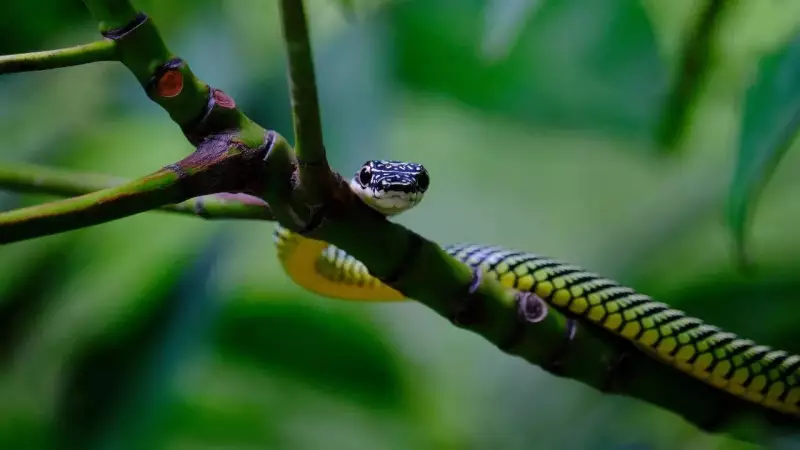
In the dense tropical forests of India and Southeast Asia, a remarkable creature defies the conventional rules of flight. The flying snake, belonging to the genus Chrysopelea, is one of the very few vertebrates capable of moving through the air without the aid of wings, membranes, or powered flight. Recent scientific studies have begun to unravel the secrets behind this extraordinary ability, revealing a complex interplay of anatomy, motion, and aerodynamics.
The Unique Anatomy of an Aerial Acrobat
What does a flying snake look like? Adult flying snakes are slender colubrids, typically measuring between 70 and 130 centimetres in length. Their most distinctive feature is a slightly flattened, laterally compressed trunk, which gives them a ribbon-like appearance even when at rest. This is a crucial adaptation for their aerial lifestyle.
Their scales are smooth and overlap tightly, creating a continuous surface that glints in the light as they move. Their colouration, which varies by species, often includes backgrounds of green, yellow, or olive, marked with black patterns like crossbars or nets. This provides excellent camouflage among the leaves and branches of their forest homes. The head is narrow and distinct from the neck, with large eyes offering a wide field of view, and the tail is long, aiding in both balance and flight mechanics.

Habitat and Hunting in the Indian Canopy
Where are these fascinating reptiles found? In India, they are part of a wider distribution across South and Southeast Asia, including Sri Lanka, Thailand, Malaysia, and Indonesia. They thrive in tropical and subtropical environments where a continuous, connected tree canopy exists. This includes lowland rainforests, dry deciduous forests, and wooded hills.
These snakes are strictly arboreal, spending most of their lives high in the mid to upper canopy. They are rarely seen on the ground, as open spaces limit their movement and increase predation risk. Their gliding ability is key to navigating this vertical world, allowing them to travel between trees without descending.
Their diet consists of small arboreal vertebrates like lizards (geckos and skinks), tree frogs, and occasionally small birds or bats. Hunting is a patient, stealthy process conducted along branches. The snake does not use gliding to catch prey mid-air; instead, its aerial skill provides efficient access to new hunting grounds across the forest canopy.
The Aerodynamic Secret: How They Generate Lift
So, how does a snake generate lift without wings? The magic happens the moment it launches from a branch. The snake dives headfirst and then performs a dramatic transformation: it spreads its ribs laterally, flattening its body into a broad, concave shape. This turns its cylindrical body into a living, aerodynamic surface.
Controlled experiments in wind tunnels, using physical models and high-speed cameras, have shown that this unique posture creates lift. As air flows over the curved body, a pressure difference between the upper and lower surfaces generates an upward force. This slows their descent and extends their horizontal glide. Research published in the Journal of Experimental Biology confirms that this lift is most effective at moderate angles of attack.
During the glide, the snake doesn't stay still. It produces graceful, lateral undulations that travel from head to tail. This wave-like motion isn't for propulsion but for stability. It helps control pitch and roll, while subtle tail movements act like a rudder for steering. The head remains relatively stable, allowing the snake to visually line up its landing on a distant branch with impressive accuracy.
The Limits of Wingless Flight
Despite their name, flying snakes cannot achieve true, sustained flight. Their movement is always a controlled descent, and they cannot gain altitude. The distance they can cover is fundamentally limited by their launch height. Environmental factors like air density, wind, and humidity also affect their performance, as does the spacing of trees in their habitat.

Dense, connected forests are ideal, supporting short, frequent glides. Wide gaps pose a significant challenge and risk. Without dedicated wings, their lift capacity is limited compared to birds or bats, firmly capping their speed and range. Consequently, the flying snake's existence is intricately tied to the health and continuity of its arboreal habitat, where its specialised form and behaviour operate within precise physical limits.
The study of these snakes extends beyond mere curiosity. It provides valuable insights into the broader field of bio-aerodynamics, showing how bodies without rigid wings can ingeniously interact with air. For India, these reptiles are a stunning example of the hidden engineering marvels thriving in its forests.





