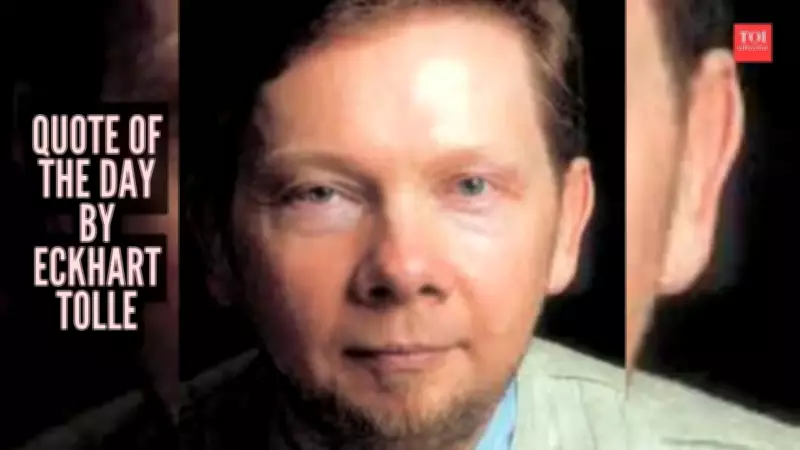
Eckhart Tolle's Transformative Journey to Spiritual Enlightenment
Eckhart Tolle stands as one of the most influential spiritual teachers of our contemporary era, with his profound ideas resonating deeply across global audiences. His bestselling books have consistently dominated international charts, offering transformative guidance that has helped countless individuals navigate life's challenges with greater clarity and peace.
The Awakening That Changed Everything
Born in Germany in 1948, Tolle experienced a dramatic spiritual awakening at age 29 following prolonged struggles with depression and existential anxiety. This pivotal moment fundamentally altered his perception of reality, forming the cornerstone of his spiritual philosophy that emphasizes living fully in the present moment.
Tolle's central teaching reveals that human suffering primarily stems from over-identification with the thinking mind, which constantly dwells on past regrets and future anxieties. By recognizing this pattern, individuals can begin to disentangle themselves from mental narratives that obscure the richness of immediate experience.

Decoding Tolle's Perspective on Time and Presence
One of Tolle's most quoted statements powerfully encapsulates his worldview: "Time isn't precious at all, because it is an illusion. What you perceive as precious is not time but the one point that is out of time: the Now. That is precious indeed. The more you are focused on time - past and future - the more you miss the Now, the most precious thing there is."
Understanding the Two Dimensions of Time
Tolle makes a crucial distinction between "clock time" and "psychological time." Clock time represents the practical, linear measurement necessary for daily functioning—scheduling appointments, meeting deadlines, and organizing life's practicalities. Psychological time, however, exists almost entirely within thought, consisting of memories, projections, regrets, and anticipations that pull awareness away from present-moment experience.
The essence of Tolle's message is that life unfolds exclusively in the present moment, and true fulfillment emerges not from chasing temporal achievements but from cultivating conscious presence. This perspective might initially appear controversial in a society that constantly emphasizes time as our most valuable commodity, but Tolle isn't dismissing practical time management—he's challenging our emotional attachment to temporal constructs.
The Profound Implications of Living in the Now
What we genuinely cherish, according to Tolle, isn't time as an abstract concept but the immediate experience occurring right now. The past exists only as memory, the future as imagination—neither can be directly experienced. Only the present moment offers authentic engagement with reality.
Escaping the Mental Noise
When Tolle declares that "the Now" represents life's most precious aspect, he invites readers to shift awareness from mental storytelling to direct perception. Constant preoccupation with future worries or past recollections diverts attention from where life actually happens, generating stress, regret, anticipation, and chronic dissatisfaction.
By anchoring awareness in the present, individuals step beyond mental chatter into clarity and tranquility. This practice reveals how frequently people miss life's richness because they're psychologically absent—physically present but mentally absorbed in yesterday's errors or tomorrow's objectives.
The Path to Inner Freedom
Tolle's teachings suggest that genuine freedom begins when consciousness returns to the Now—to breathing, sensing, observing, and simply being. In this state, life feels more complete, serene, and meaningful. His description of time serves as a poignant reminder that we cannot live outside the present moment, though we often attempt to through excessive identification with past and future constructs.
While maintaining some awareness of chronology remains practical for functioning, over-identification with temporal concepts causes loss of present-moment engagement. Life's value derives not from time's quantity but from experience's quality.

The Lasting Impact of Tolle's Spiritual Legacy
Through recognizing the Now's profound value, practitioners can experience mental stillness and deepen their connection to existence itself. Tolle's teachings, while elegantly simple, offer extraordinary depth, conveying that transcending psychological time reveals the richness that has always resided within.
His work continues to guide millions toward more conscious, peaceful living, demonstrating that spiritual awakening isn't about acquiring something new but remembering what has always been present beneath layers of mental conditioning.