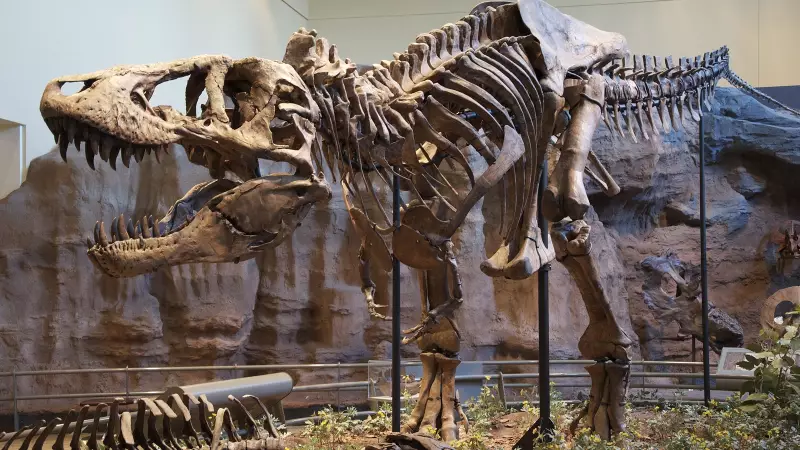
When imagining the most fearsome predators of Earth's past, colossal beasts like the Tyrannosaurus rex and the massive shark Megalodon instantly come to mind. However, a startling scientific revelation has shifted the spotlight to a creature that was neither large nor intimidating in appearance. The title for the sharpest teeth in history belongs to a diminutive, ancient swimmer known as the conodont.
The Microscopic Champion: Conodont's Razor-Sharp Bite
Conodonts were small, jawless animals that inhabited the world's oceans over 500 million years ago, long before dinosaurs walked the Earth. Far from being monstrous, they were almost eel-like in form. The true marvel of these creatures was discovered under powerful microscopes: their dental structures, called elements, possessed tips of unimaginable sharpness.
These tooth tips measured a mere two microns in width, which is significantly thinner than a single strand of human hair. Despite their minuscule size, these teeth were incredibly effective tools for predation. Scientists believe conodonts used them to cut, grasp, and grind their food with extreme precision. Their efficiency was so remarkable that a 2020 study published in Scientific American officially declared conodont teeth as the sharpest ever discovered in the entire animal kingdom.
Prehistoric Dental Oddities: The Chainsaw Shark
While conodonts win the prize for sharpness, the award for the most bizarre dental arrangement undoubtedly goes to the Helicoprion. This ancient fish, which lived approximately 270 million years ago, has earned the nickname "chainsaw shark" due to its unique fossil remains.
For decades, paleontologists were puzzled by the Helicoprion's strange spiral of teeth found in the fossil record. It is now understood that this tooth whorl was located inside the creature's lower jaw. The mechanism likely functioned like a circular saw; as the Helicoprion closed its mouth, the spiral of teeth would rotate, slicing into soft-bodied prey such as ancient squid. Though not as microscopically sharp as conodont elements, these teeth were highly specialized for cutting and holding.
Brute Force vs. Surgical Precision
This discussion naturally leads to the question of where legendary giants like Megalodon fit in. The prehistoric mega-shark possessed truly enormous, serrated teeth, some reaching lengths of seven inches. Its bite force is estimated to have been a crushing over 180,000 newtons, dwarfing even that of T. rex.
However, Megalodon's teeth were built for power and crushing, making them relatively blunt when compared to the needle-like precision of the conodont's dental tools. The distinction highlights different evolutionary strategies: one focused on overwhelming brute force, the other on surgical sharpness.
In summary:
- Conodonts claimed the crown for the sharpest teeth, using tiny, ultra-sharp elements as precise cutting tools.
- Helicoprion boasted the weirdest teeth, employing a unique spiral whorl that operated like a saw.
- Megalodon relied on sheer brute force, with massive jaws and teeth designed for maximum crushing power.
While Tyrannosaurus rex and Megalodon will forever remain icons of prehistoric terror, the ultimate accolade for dental sharpness has been awarded to an ancient, unassuming ocean dweller. The conodont's story is a powerful reminder that in the natural world, size isn't everything, and sometimes the most extraordinary weapons come in the smallest packages.