

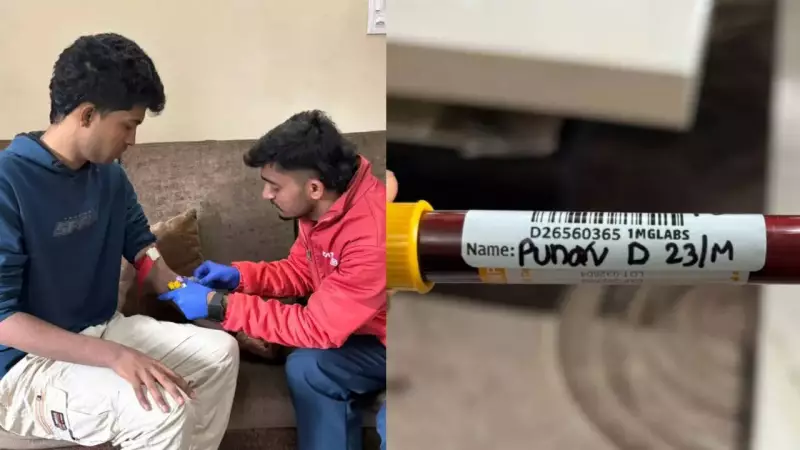
A 23-year-old entrepreneur from Bengaluru is capturing the internet's attention with a radical, deeply personal health experiment. Punarv Dinakar, who boldly claims to be the 'future Bryan Johnson of India', is not just chasing longevity but is on a mission to optimise every facet of his existence through rigorous biological tracking.
The Bengaluru Biohacker's Blueprint
Unlike the common use of fitness apps and wearables, Dinakar's approach is far more intensive and data-driven. As the founder of Sedona Health, a startup focused on health data and biomarker tracking, he is applying a systematic, entrepreneurial mindset to his own biology. He began with an extensive blood test costing Rs 7,000 to establish a detailed baseline of his biomarkers.
His daily monitoring toolkit is comprehensive:

- Sleep patterns and strain levels via a WHOOP device.
- Physical activity tracking through Strava.
- Calorie measurement software.
- His own Sedona platform to analyse biomarker variability.
For Dinakar, this is merely the starting point for a grand exploration of his body's parameters. He clarifies that his goal diverges from figures like Bryan Johnson. "My objective is to live life to the fullest," he states. "Data is more about using it to increase the power, the focus, the overall quality of living. It is not about immortality."
Inspired by Bryan Johnson, But Charting a Different Path
The reference to Bryan Johnson is inevitable. The US entrepreneur has become the global face of extreme self-quantification, spending millions annually on a regimen designed to reverse his biological age. While Dinakar draws inspiration from this methodical approach, he emphasises a philosophical difference. His project is framed as a personal commitment and an adventure in self-discovery, rather than a purely anti-ageing crusade.
This experiment highlights a significant shift among younger professionals who view health not as a passive state but as an active, optimisable system. The convergence of wearable tech, apps, and accessible health data is creating a new culture of self-surveillance, where optimised health becomes a subject of endless monitoring and refinement.
Online Reactions: Admiration, Anxiety, and Debate
The public reveal of Dinakar's project on social media has sparked a firestorm of mixed reactions. The online community is sharply divided.
Many admire his discipline, foresight, and the openness of his experiment. Some have even expressed a desire to embark on similar health optimisation challenges. However, critics and skeptics are equally vocal. Some question his motivations, wondering if this is for genuine benefit or mere personal entertainment. Others joke about the immense pressure of such intense self-tracking at a young age.
A significant point of concern raised is the potential for anxiety. Critics suggest that basic practices like a balanced diet, regular exercise, and adequate sleep might be sufficient for most, and that constant data monitoring could be overwhelming rather than transformative.
Regardless of where one stands, Punarv Dinakar's extreme health-tracking experiment has successfully reignited a crucial conversation about the limits, benefits, and future of personal health optimisation in the digital age.






