Bengaluru Experts Redefine Phone Addiction: It's About Control, Not Just Screen Time
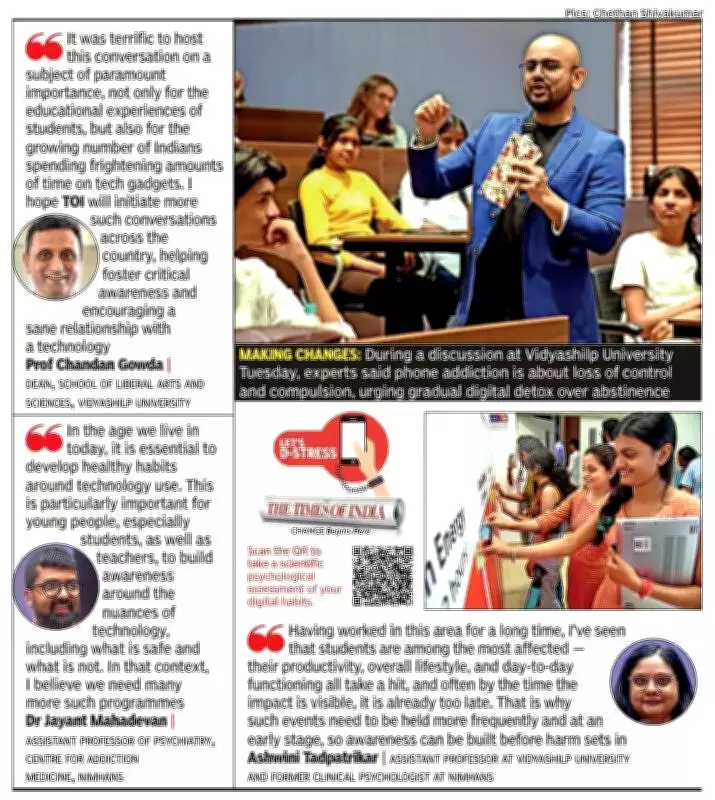
In Bengaluru, a critical discussion at Vidyashilp University has challenged conventional views on smartphone dependency. As part of The Times of India's Let's D-Stress initiative, mental health professionals moved beyond simplistic screen-time metrics to explore the deeper psychological mechanisms of addiction.
Beyond the Clock: Understanding True Addiction Indicators
During an interactive session with students, many participants confessed to spending over ten hours daily on their devices. However, experts emphasized that addiction cannot be measured by a universal time threshold. Ashwini Tadpatrikar, assistant professor at Vidyashilp University and former clinical psychologist at the National Institute of Mental Health and Neurosciences (Nimhans), clarified this nuanced perspective.
"There is no magic number that determines safety versus harm," Tadpatrikar stated. "The real indicators emerge when individuals lose control over their usage, experience compulsive urges to constantly check their phones, and face tangible consequences in their daily lives."

She provided a relatable example: "You might be working on an important assignment but repeatedly get distracted by your phone. Time slips away, tasks are postponed indefinitely, and everything gets pushed to the last minute—this pattern reveals problematic behavior beyond mere duration."
The Neuroscience Behind Digital Compulsion
Dr. Jayant Mahadevan, assistant professor of psychiatry at Nimhans' Centre for Addiction Medicine, highlighted how platform design exploits human psychology. He explained the powerful role of variable reinforcement schedules in social media applications.
"Most social media apps operate on a variable schedule where users cannot predict when they will receive rewards like likes or notifications," Dr. Mahadevan elaborated. "This uncertainty triggers dopamine release in the brain, creating a reinforcing loop that keeps users returning repeatedly, much like gambling mechanisms."
Practical Strategies for Digital Regulation
Rather than advocating for complete abstinence—which often proves unsustainable—experts recommended gradual, structured approaches to digital consumption. Tadpatrikar proposed implementing digital detox periods and intermittent digital fasting as effective methods.
"The solution isn't about cutting off technology completely, as that approach frequently fails," she advised. "Instead, focus on progressively reducing usage while incorporating technology-based regulatory tools. Simultaneously, cultivate non-digital activities to create healthier behavioral alternatives."
Dr. Mahadevan supplemented this with actionable self-control techniques:
- Internal Regulation: Develop personal motivation and establish specific technology-free time blocks
- External Regulation: Make access more difficult by disabling features like infinite scroll or physically distancing devices
This comprehensive approach addresses both the psychological drivers and environmental triggers of excessive smartphone use, offering sustainable pathways to healthier digital habits.