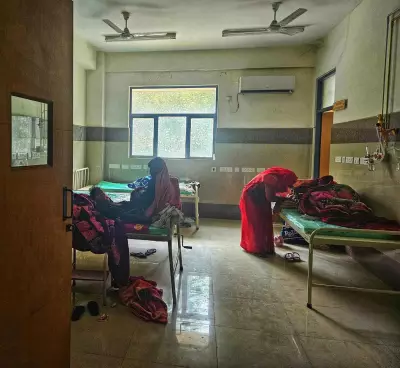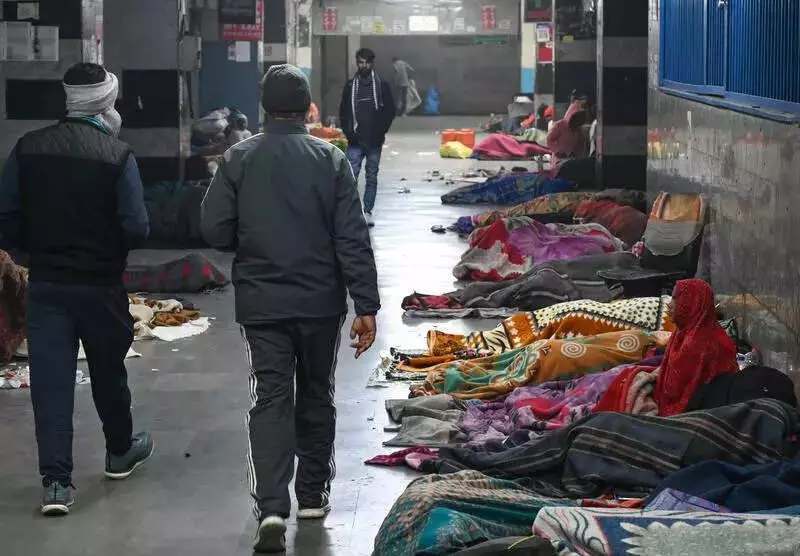
As winter's chill grips the national capital before dawn, a heartbreaking scene unfolds daily outside the gates of the All India Institute of Medical Sciences (AIIMS). Hundreds of patients and their family members, having travelled from distant states, brace the cold on pavements, under flyovers, and inside subways, forming a desperate queue for a chance at medical care.
A Desperate Routine for Hope
For thousands, this is not an anomaly but a grim routine. They arrive from states like Bihar, Uttar Pradesh, and Rajasthan, carrying their ailments and documents, only to find that the struggle extends beyond the hospital walls. With night shelters around AIIMS severely overcrowded and often deemed too far to risk missing a crucial appointment, the pavement becomes their temporary home.
In the early hours, one can see what looks like piles of rags from a distance transform into families huddled together for warmth under thin blankets. Sixteen night shelter tents exist around AIIMS, each with a capacity for 20 people, but on a recent Friday night, all were over-occupied. This contrasts sharply with the city's other shelters, where only 6,356 of 19,984 spots were filled, underscoring the acute desperation concentrated at the hospital's doorstep.

Personal Battles on the Pavement
Among them is 31-year-old Rajesh Kumar from Bhagalpur, Bihar. Awake at 4 am, he uses his leg, swollen from elephantiasis, as a makeshift table to organize his medical papers. "At one hospital, they said amputation was the only way," he shares. "Here, the referrals are frustrating, but there is hope. That hope keeps me going through these freezing nights."
A few meters away lies 60-year-old Rajpal, with a feeding tube secured to his nose due to a knot in his food pipe. For over a year and a half, he and his wife have made this pavement their temporary base. On the litter-strewn ground, he personally prepares and administers his milk feed via a syringe, a testament to the extreme self-reliance forced upon them.
An Unspoken System of Survival
A strict, unspoken code governs this outdoor life. Everyone must wake up before dawn to secure appointment slips; being minutes late can mean losing the day's chance to see a doctor. There's also a code of protection, with men ensuring women sleep closer to walls or corners, a precaution against vulnerability heightened by darkness and crowding.
The nearby subway, though unhygienic, offers relative warmth and is packed to capacity. Sangeeta, 35, from East Delhi's Gandhi Nagar, cradles her four-month-old son with a congenital heart defect inside. "Sleeping outside is too dangerous for him," she says, explaining that even a 10-minute delay from home could mean losing their hard-won appointment and restarting the agonizing queue.
Nearby, 45-year-old Muwasareen from Uttar Pradesh, who needs assistance to stand, endures the subway despite occasional harassment. "Sometimes people throw cold water on us," she reveals, yet the need to be close to the hospital outweighs the indignity.
Night after night, these individuals find themselves in a painful limbo, caught between debilitating illness and a system that offers potential treatment by day but abandons them to the cold by night. Their silent vigil on Delhi's streets is a stark indictment of the gaps between India's premier healthcare institutions and the basic humanity owed to those who seek its help.