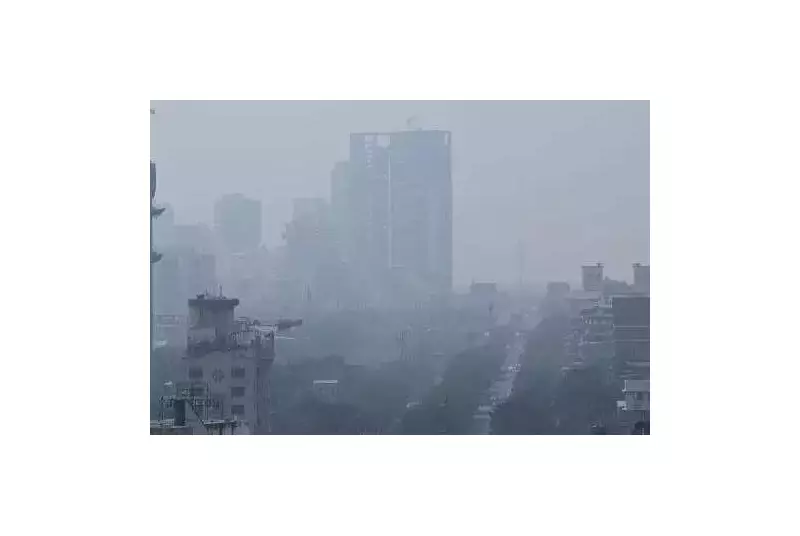
Navi Mumbai is grappling with a severe public health crisis as its air quality has remained in the 'severe' to 'hazardous' category for nearly a week. Environmental groups have declared an "air emergency," warning that the city has entered a danger zone for residents' health.
Alarming Pollution Levels and Health Impact
On Wednesday morning, the citywide Air Quality Index (AQI) touched a worrying 339, firmly placing it in the hazardous range. The situation was particularly dire in the Sanpada node, which recorded an AQI of 405 on Wednesday, following an extreme reading of 647 the previous day. According to data from the monitoring platform aqi.in, breathing air of this quality is equivalent to the health impact of smoking about 7.7 cigarettes a day, or nearly 230 in a month.
Activist B N Kumar, director of the NatConnect Foundation, highlighted the widespread nature of the problem. He pointed to Owe village near Kharghar Hills, surrounded by quarry activity, where the AQI touched a hazardous 514 early in the morning. Meanwhile, the overall Navi Mumbai AQI stood at a 'severe' 297.

Root Causes and Official Inaction
Environmentalists have pinpointed several key contributors to this dangerous episode. They cite unchecked construction and redevelopment activity, quarry dust, rising vehicular emissions, and weak enforcement of pollution-control norms as the primary culprits. The pollution is not confined to one area; data shows hazardous levels along Palm Beach Road, severe pollution in Kharghar and Seawoods, and unhealthy air in parts of Vashi.
Despite the alarming data, civic authorities from the Navi Mumbai Municipal Corporation (NMMC) dismissed the aqi.in readings as "unreliable." Environmentalists countered this, stating that the platform is operated by a reputable environmental technology firm and is widely used to assess pollution trends, especially during extreme episodes.
A Call for Coordinated Action and Political Accountability
Activists argue that this crisis exposes a systemic failure to treat air pollution as a public health emergency. Vishnu Joshi, convenor of the Parsik Hills Greens Forum, highlighted glaring enforcement gaps. "Construction is happening across Navi Mumbai, but dust-control Standard Operating Procedures (SOPs) are not enforced on the ground," he said. Measures like water sprinkling, green netting, covered transport of debris, and proper site barricading are routinely ignored.
Jyoti Nadkarni of the Kharghar Hill and Wetland Forum emphasized the role of quarrying, stating that hill zones have become pollution hotspots. "Dust from quarry operations around Owe and Kharghar is directly adding to the city's pollution load," she noted.
In response, environmental groups are demanding a coordinated response involving the NMMC, CIDCO, MMRDA, and the Maharashtra Pollution Control Board (MPCB), moving away from fragmented measures. They are also urging citizens to raise air quality as a critical issue ahead of the January 15 municipal elections, reminding everyone that the right to breathe clean air is enshrined in Article 21 of the Constitution, which guarantees the right to life.