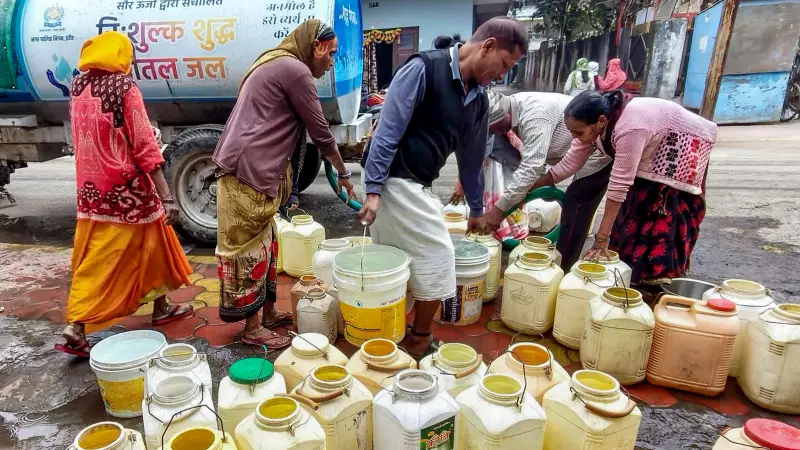
The crown jewel of India's Swachh Bharat mission, Indore, is grappling with a devastating civic crisis that has tarnished its meticulously crafted image. Days before the new year, the city's celebrated 'cleanest in the country' tag was called into question following a tragic outbreak of waterborne illness. Between December 24, 2025, and January 6, 2026, at least eight people lost their lives after allegedly drinking contaminated water in the densely populated Bhagirathpura area.
A City's Shine Tarnished by Tragedy
Indore, which topped India's cleanliness rankings for seven consecutive years until 2023 and was declared the country's first 'water plus' city in 2021, now faces a grim reality check. The Madhya Pradesh government confirmed the eight deaths before the High Court. Health officials reported that 310 patients were admitted to hospitals since the outbreak began, with 203 still hospitalized, including 25 in intensive care units.
The initial investigation pointed to a public toilet, built without a mandatory septic tank over an ageing pipeline near a police outpost, as the source of contamination. Although the toilet has been demolished, authorities are now probing whether the contamination spread through the local borewell network. In a symbolic gesture, government officials publicly drank from water tankers to assuage public fear, even as health workers conducted door-to-door screenings in the affected zone.
Ageing Pipelines and Missed Warnings
Beneath the surface of the immediate tragedy lies a deeper story of neglected infrastructure and systemic failure. The crisis prompted a swift administrative reshuffle, with Kshitij Singhal replacing Dilip Kumar Yadav as the Indore Municipal Corporation (IMC) Commissioner on January 2, 2026. Singhal now faces the arduous task of restoring public faith in the municipal water supply.
"We are tracking the source of contamination in the borewell system. The pollution board has examined nearby industries for leaks. The pipeline network that allowed the contamination to spread is under review too," Singhal told The Indian Express. The crisis has exposed a stark divide in the city's water infrastructure, a legacy of its rapid, unplanned growth.
Indore's current population exceeds 30 lakh and is projected to reach 58.70 lakh by 2040, requiring approximately 1,100 million litres per day (MLD) of treated water. While the city's installed capacity from surface sources like the Narmada, Yashwant Sagar, and Bilawali totals 594 MLD, it heavily relies on 4,945 tube wells and 1,004 hand pumps to offset the shortfall. The district environment plan estimates a staggering 1,51,939 borewells across the district, most unregulated.
The water distribution network is a tale of two cities. Newer areas have modern High-Density Polyethylene (HDPE) pipes designed to last a century. In contrast, older neighbourhoods like Bhagirathpura are serviced by asbestos-cement pipes laid in the early 1990s. "These systems were never designed for today's pressure, population load, or continuous supply," an area engineer overseeing water infrastructure revealed.
Bhagirathpura: A Case Study in Neglect
Bhagirathpura stands in stark contrast to Indore's shining facade. Its narrow lanes house a chaotic web of pipelines where drinking water and sewage lines run dangerously close. A senior sewage department official described the network as "laid haphazardly," with incomplete integration between old and new systems.
Alarm bells had been ringing for months. The family of 50-year-old Seema Prajapat, one of the victims, claimed they were among the first to raise an alarm. Her son, Arun Prajapat, stated that despite complaints on the Mayor's helpline about foul-smelling water, no action was taken until after her death. In 2025 alone, the corporation logged 266 water quality complaints, with 23 formal complaints from Zone 4, which includes Bhagirathpura.
Despite a resolution dated November 25, 2022, approving a comprehensive Rs 2.38 crore pipeline project for Ward No 11 of Bhagirathpura, the work progressed slowly. The state informed the High Court that "80% of the work on the pipeline was completed" before the tragedy. An official admitted, "The old lines were supposed to be abandoned but delays... meant that old ones continued to be in use. The contamination was detected in old lines."
Systemic Failures and the Aftermath
The tragedy has exposed deep-seated institutional flaws. A 2018 Comptroller and Auditor General (CAG) audit of 20 IMC water samples found all had contaminants exceeding prescribed BIS norms, posing risks of liver damage, diabetes, diarrhoea, and typhoid. The IMC's response at the time blamed "very old" pipelines damaged by construction works.
A 2023 National Green Tribunal (NGT) committee report highlighted that the IMC failed to account for illicit water extraction by nearly 910 illegal colonies. The 2024 Indore District Environment Plan further flagged that IMC's pipelines were "damaged and choked at many places."
In the aftermath, disciplinary action was swift. Former Commissioner Yadav and former Additional Commissioner Rohit Sisonia were found to have delayed pipeline fixes and failed to monitor complaints. Public Health Engineering Department's Superintendent Engineer Sanjeev Shrivastava was found to have ignored complaints, while his subordinates were dismissed for not repairing leakages. Eleven small industries in Bhagirathpura are also under probe.
Engineers on the ground are calling for systemic reform. A senior IMC official highlighted chronic understaffing: "Engineers are overburdened... A city of this size needs at least 300 to 400 engineers. There has to be a dedicated engineering corps." Another engineer pointed to the erosion of technical capacity due to frequent transfers and excessive workloads.
The Indore water contamination crisis is more than a public health failure; it is a stark reminder that awards and accolades cannot mask crumbling infrastructure. As the city races to replace its ageing pipelines and restore trust, the question remains: can the 'cleanest city' clean up its act from the inside out?