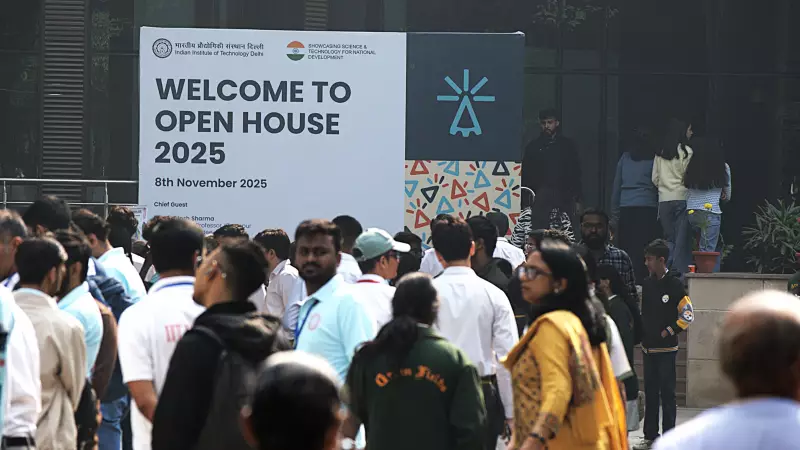
The Indian Institute of Technology Delhi recently hosted its 18th Open House event, transforming the campus into a vibrant showcase of scientific innovation that attracted over 3,500 visitors. The November 2025 event featured more than 200 scientific posters and live demonstrations across 20 laboratories, highlighting research spanning diverse domains from artificial intelligence to national security.
Air Pollution's Silent Threat to Unborn Children
Among the most compelling revelations came from Doris Seyinde, a researcher at IIT Delhi's Centre for Atmospheric Sciences, who presented findings from her seven-year study on air pollution's impact on birth outcomes. Her research examined data from Nigeria between 2012 and 2018, revealing alarming connections between PM2.5 pollution and adverse birth outcomes.
"We've discovered that exposure to higher levels of PM2.5 increases the risk of low birth weight by 8%, preterm birth by 6%, and stillbirth by 4%," Seyinde explained. The researcher, originally from Lagos, emphasized that these tiny particles can cross from lungs into the bloodstream, circulating throughout the body including to developing fetuses.

The study identified significant socioeconomic disparities in pollution exposure. "A rich person will not be living in a slum. A slum is more polluted," Seyinde noted, highlighting how poorer communities often rely on biomass cooking fuels that generate higher PM2.5 concentrations compared to cleaner alternatives like cooking gas used by wealthier populations.
Perhaps most crucially, the research pinpointed the first trimester as the period when developing babies are most vulnerable to pollution effects. "We think that is when the baby is developing most critically. So mothers need to be very careful in the very first trimester," Seyinde stressed.
Workplace Anxiety in the Age of Artificial Intelligence
While some researchers tackled environmental health threats, others examined psychological challenges in the modern workplace. Shweta Kumari Choudhary from the Department of Management Studies investigated what she terms "the GenAI anxiety epidemic" among working professionals.
"My research talks about how generative AI is creating fear among working professionals who think that generative AI will soon or later replace them in their organizations," explained Choudhary, a second-year PhD student.
Through extensive interviews with employees actively using AI tools, Choudhary uncovered deep-seated anxieties. "Whenever I talk to them about generative AI, they get triggered. They feel insecure about their future," she reported. One professional confessed: "I am a researcher, but I am not very good at the coding part. So my skills are getting obsolete."
However, Choudhary's research also identified adaptive strategies emerging from workers themselves, including:
- Seeking collaboration between human creativity and AI capabilities
- Networking with peers facing similar challenges
- Continuous skill enhancement and professional development
- Demanding organizational culture transformation
"The technology part and the human part should work together," Choudhary emphasized, advocating for a balanced approach to AI integration.
Antibiotic Resistance Hidden in Everyday Food
Another critical health concern emerged from research presented by Shikha Balayan from the Centre for Rural Development and Technology, who uncovered disturbing connections between poultry farming practices and antibiotic resistance.
"Antibiotics are given to small chicks from day one for disease prevention because the mortality rate is higher in chickens," Balayan explained. The problem extends beyond the animals themselves through what researchers call "trophic level transfer" - where antibiotics given to chickens transfer to eggs and subsequently to humans consuming these products.
Balayan's systematic review of ten years of data found that poultry products and eggs primarily contained residues of tetracyclines and fluoroquinones. The economic reality of poultry farming makes widespread antibiotic use practical, as she noted: "It's easier to mix antibiotics in the whole feed than to individually medicate chickens."

To address this public health threat, Balayan's team is developing rapid detection kits that work similarly to pregnancy tests, using antibody-antigen interactions to identify specific antibiotics in meat or eggs. Priced at approximately ₹100 per test, these consumer-centric kits would allow anyone to test poultry products within minutes by pounding the meat, placing it in an extraction buffer, and reading the results.
"We are targeting people who buy from local stores," Balayan emphasized, addressing the gap between regulatory standards and enforcement reality in Indian markets.
The Open House event successfully demonstrated IIT Delhi's commitment to addressing India's most pressing challenges through innovative research across multiple disciplines, from environmental science to workplace psychology and food safety.