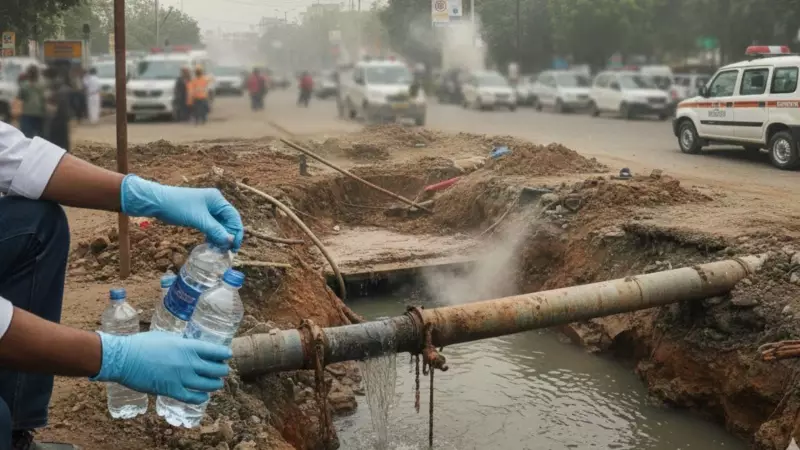
A major public health crisis has erupted in Gujarat's capital, Gandhinagar, where more than 100 suspected cases of typhoid have been linked to a dangerous mix of drainage water and the drinking water supply. The contamination, traced to leaking pipelines, has prompted authorities to swing into action on a "war footing."
Outbreak Triggers Swift Response
The Gandhinagar Municipal Corporation (GMC) and state health authorities have launched a massive containment effort. More than 100 cases of suspected typhoid have been detected, with over 90 patients currently under treatment at Gandhinagar Civil Hospital and local health centres. Officials confirm all patients are in stable condition, with around 20 having been discharged after treatment.
The scale of the response is significant. Seventy-five dedicated health teams are working on the ground, while municipal staff have been pressed into service to inspect over 20,800 houses, covering a population exceeding 90,000. Round-the-clock outpatient departments (OPDs) have been established in the affected zones, and food arrangements have been made for relatives of those hospitalized.
Union Home Minister and Gandhinagar MP Amit Shah has been in constant touch with the state government regarding the situation. Following his discussions with Deputy Chief Minister Harsh Sanghavi and other officials on Sunday, immediate orders were issued to repair leaking pipes and conduct inspections in surrounding areas to prevent the outbreak from spreading further.
Residents Report Foul-Smelling Water for Weeks
While Municipal Commissioner J N Vaghela stated the first official complaints were received on December 29, several residents report a much longer period of problematic water supply. Residents from affected areas, including Sectors 24, 26, 28, and Adiwada, describe receiving foul-smelling, visibly contaminated water for up to 20 days or, in some claims, since November.
"The water seemed like someone had mixed cement powder with it," said Asha Pandya, a resident of Shrinagar, whose 14-year-old son was diagnosed with typhoid but has since recovered. Malti Kori, a 32-year-old from Adiwada, narrated a harrowing tale of her 6-year-old son falling ill. "We got such water continuously for four-five days... That one day was enough to make my son ill. He had a fever and stomach ache," she said, adding that many in her locality show similar symptoms.
Commissioner Vaghela admitted that the water was "not potable" earlier but claimed that after repairing 21 leaks and initiating chlorination tests, the supply is now safe. He attributed the crisis to water contamination due to the mixing of drainage and drinking water. A senior GMC Health Department official stated they are treating the situation as "an epidemic."
Medical Alert and Long-Term Concerns
Medical Superintendent of Gandhinagar Civil Hospital, Dr. Mita Parikh, warned that since the incubation period for typhoid is 10-15 days, fresh cases are expected daily until around January 20. Most patients are children and teenagers, aged between 1 and 16 years.
A top official at the civil hospital confirmed that a surge in complaints of high-grade fever, abdominal pain, and vomiting began on December 29. Rapid Response Teams dispatched to the areas found evidence of water-borne diseases. "Various samples were taken and they showed faecal contamination," the official revealed. A private doctor from an affected area, speaking anonymously, said she had treated about 25 typhoid patients since December 20, with another 25 showing symptoms.
The political ramifications are also in focus, especially after a similar contaminated water crisis led to deaths in Indore, Madhya Pradesh. The Gandhinagar outbreak has seen local corporators, like Gajendrasinh Vaghela of Ward 2 (which includes Adiwada), claim they were unaware of complaints until informed by the media. Meanwhile, authorities are conducting awareness campaigns and distributing chlorine tablets and ORS packets in the affected neighbourhoods. Commissioner Vaghela also mentioned a long-term project to replace old pipelines in areas like Adiwada village.