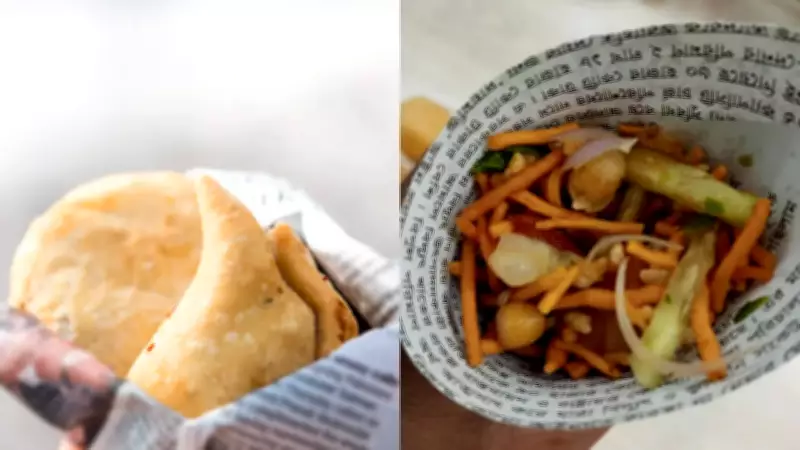
The Food Safety and Standards Authority of India (FSSAI) has issued a strong warning against the use of newspapers for wrapping and serving food. This practice, common among street food vendors for items like samosas, bread pakodas, and jhal muri, is now prohibited due to serious health risks.
What Did FSSAI Say?
FSSAI reiterated that newspapers cannot be used for packing, wrapping, or serving food items, citing health hazards from printing ink and unhygienic handling. The directive follows a recent incident in Mumbai where a vada pav vendor was found using newspapers. FSSAI's Western Region and the Brihanmumbai Municipal Corporation (BMC) conducted a joint inspection and took action.
FSSAI has directed all food business operators—including street vendors, restaurants, cloud kitchens, caterers, quick-service restaurants (QSRs), food stalls, mobile vendors, and small retailers—to immediately stop using newspapers or similar printed materials for any food-related purpose.

Health Risks Identified
According to FSSAI, newspaper ink contains chemicals, pigments, binders, and colorants that can pose health risks when in contact with food. Printing inks may contain lead and other heavy metals, which can leach into food and cause long-term health complications. Additionally, newspapers are often exposed to dust, dirt, and unsanitary conditions during printing, transportation, and distribution, making them potential carriers of harmful pathogens.
Existing Regulations
The use of newspapers for storing, wrapping, or serving food is already prohibited under the Food Safety and Standards (Packaging) Regulations, 2018. FSSAI clarified that newspapers should not be used even for absorbing excess oil from fried items like samosas, pakoras, and vada pav, nor for covering or storing prepared food.
The regulatory authority urged food businesses to use only approved food-grade packaging materials to ensure consumer safety. It also appealed to consumers to remain vigilant and avoid purchasing food served in newspapers. FSSAI is working closely with State Food Authorities to monitor and enforce regulations, and to promote awareness among the public.