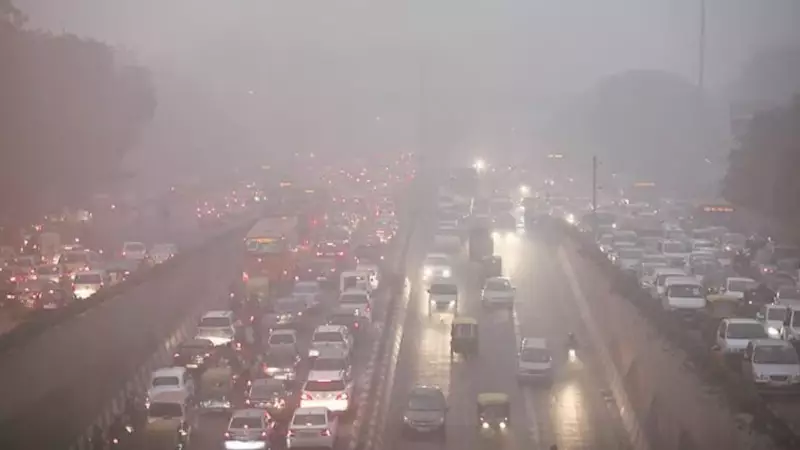
After enjoying a marginal improvement for just two days, the national capital was once again shrouded in hazardous air on Friday, December 27, 2025. Delhi's air quality index (AQI) witnessed a sharp spike, plunging back into the 'Very Poor' category and signalling a return of the familiar winter pollution crisis.
Sharp Deterioration Across the NCR
The data presented a grim picture. Delhi's overall AQI was recorded at 332 on Friday, a significant jump from 234 on Thursday and 271 on Wednesday. The situation was equally alarming in the broader National Capital Region (NCR). Noida registered an AQI of 376, while Gurgaon recorded 312, both indicating a severe decline from their previous day's readings of 256 and 239 respectively.
Out of the 38 functional monitoring stations in Delhi, eight entered the 'Severe' zone, with AQI readings soaring above 400. Forecasts indicate that the capital is likely to grapple with 'Very Poor' air quality for the next six days, offering little hope of immediate relief to its residents.
Primary Polluters and External Contributions
According to analysis from the Indian Institute of Tropical Meteorology's Decision Support System, vehicular emissions were the single largest contributor to Delhi's pollution on Wednesday, accounting for 19.7% of the particulate matter. This was followed by industries within the city and its periphery at 10.1%, and residential sources at 4.9%.
The pollution load was not solely homegrown. Data revealed significant contributions from neighbouring districts in Haryana. Jhajjar topped the list, contributing a substantial 20% to Delhi's pollution, followed by Sonipat and Panipat at 4% each, Gurgaon at 4%, and Rohtak at 2.3%.
Government Crackdown and Countermeasures
In response to the escalating crisis, government authorities have intensified enforcement and announced new measures. Chief Minister Rekha Gupta highlighted efforts to curb vehicular pollution through automated commercial vehicle fitness testing stations. The centre at Jhuljhuli in South West Delhi is already operational, testing about 70,000 vehicles annually, while the Burari centre is being upgraded.
Two new centres at Nand Nagri and Tehkhand are expected to be operational by March 2026. Collectively, these four centres will have the capacity to test approximately 2.5 to 3 lakh commercial vehicles every year. The government has also approved five additional automated testing stations at various DTC depots, including Bawana and Ghazipur.
On the enforcement front, Transport Minister Pankaj Singh reported that around 28 goods-carrying buses were impounded on Friday for violating pollution norms, bringing the total for the month to about 100. In the last 24 hours, a massive drive saw 4,927 vehicles inspected, resulting in thousands of challans by Delhi Traffic Police and Transport Enforcement for lacking valid Pollution Under Control Certificates (PUCC).
Authorities have also suspended 28 PUC centres, shut down two units, and initiated action against two more over discrepancies in issuing certificates. In a serious case of alleged malpractice, a police complaint has been filed against a PUC centre at Gokulpuri for issuing forged PUCCs.
With the India Meteorological Department forecasting dense fog over the coming days alongside low wind speeds, the meteorological conditions are set to trap pollutants further. The battle for breathable air in Delhi continues, with systemic solutions and stringent enforcement being tested against the annual environmental challenge.