

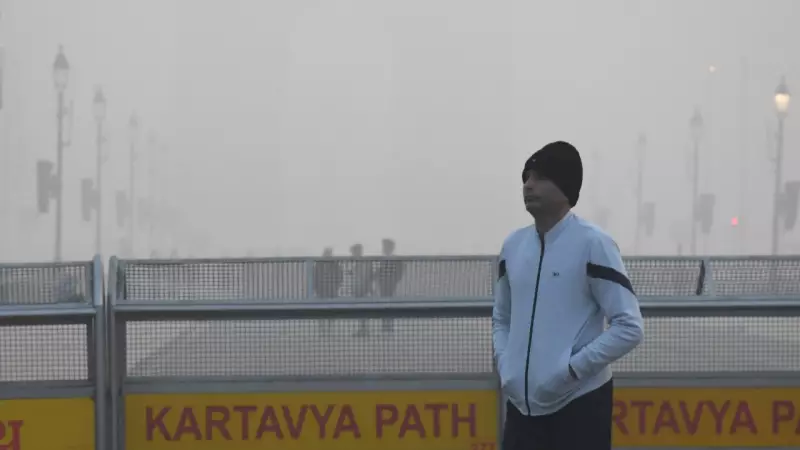
Residents of Delhi and the National Capital Region (NCR) began their Thursday shrouded in a dense layer of fog, which drastically reduced visibility and compounded concerns as air quality remained firmly in the 'very poor' category.
Pollution Levels and Worst-Hit Areas
Data from the Central Pollution Control Board (CPCB) recorded the overall Air Quality Index (AQI) at 372 at 7 am. A detailed station-wise analysis revealed a grim picture: 29 monitoring stations reported 'very poor' air quality, while an additional 7 stations slipped into the 'severe' category. The location suffering the most was Anand Vihar, which logged a dangerous AQI of 421, as per data from the CPCB's SAMEER app.
According to CPCB standards, an AQI between 301 and 400 is classified as 'very poor', and readings from 401 to 500 are considered 'severe'.

Weather Conditions and Forecast
The India Meteorological Department (IMD) reported chilly weather accompanying the fog. The minimum temperature at Safdarjung and Ayanagar was 6.4 degrees Celsius, which is about 0.4 degrees below the seasonal average. Other areas like Palam, Lodhi Road, and The Ridge recorded minimums of 7.7, 6.8, and 7.8 degrees Celsius respectively. The maximum temperature is expected to be around 23 degrees Celsius, with dense fog likely to linger throughout the day.
For New Year's Day, the IMD has predicted a generally cloudy sky with the possibility of light rain over the national capital.
Reasons and Long-Term Outlook
Officials attributed the persistently high pollution levels to unfavorable meteorological conditions. These include a low ventilation index of below 6,000 square metres per second and weak wind speeds under 10 kmph, which together prevent the effective dispersion of pollutants. The Air Quality Early Warning System has issued an alert, stating that air quality is likely to remain in the 'very poor' category for the next six days.
While Tuesday's AQI of 388 showed a marginal improvement from Monday's severe reading of 401, the relief is minimal. A new analysis by the Centre for Research on Energy and Clean Air (CREA) highlighted that Delhi remained the most polluted city in the NCR in 2025, followed by Ghaziabad and Noida.
The CREA study noted that although Delhi's annual average PM2.5 concentration declined compared to the previous year, the polluted-season average from October to December saw a slight increase over 2024 levels. Alarmingly, PM2.5 levels at all 40 monitoring stations in Delhi were at least 1.8 times the prescribed annual standard. The report also underscored significant gaps in regional air quality monitoring, revealing that 15 cities in Haryana, including Faridabad and Gurugram, had inadequate data coverage.






