

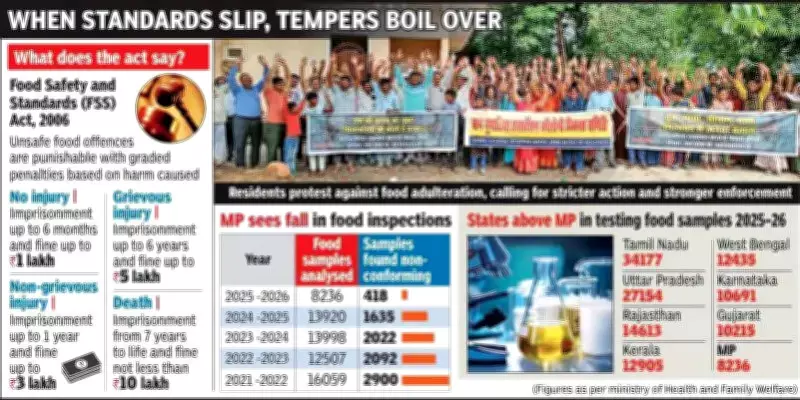
Bhopal Residents Rally Against Food Adulteration, Call for Stricter Penalties
In a significant demonstration of public concern, residents of Bhopal's Bagmugaliya locality have taken to the streets to protest the escalating issue of food adulteration. The protest, organized under the banner of the Bagmugaliya Extension Colony Development Committee on March 29, highlighted growing fears over contaminated food items and demanded stringent government action, including the provision of capital punishment for offenders.
Alarming Decline in Food Sample Testing
Government figures reveal a troubling trend in food safety oversight in Madhya Pradesh. According to union government data, the number of food samples analyzed in the state has plummeted by nearly half over the past five years. In 2021-22, a total of 16,059 food samples were tested, but this number dropped sharply to 8,236 in 2025-26. This decline has pushed Madhya Pradesh to the 8th position in the country for food sample analysis, indicating a potential lapse in regulatory priorities.
Voices from the Protest
Umashankar Tiwari, President of the Bagmugaliya Extension Colony Development Committee, articulated the gravity of the situation during the protest. He emphasized that while terrorist incidents affect specific individuals and families, food adulteration poses a widespread threat to every citizen, leading to serious illnesses and fatalities. "The level of adulteration is increasing in milk, ghee, khoya (mawa), paneer, pulses, rice, spices—almost everything," Tiwari stated. "When people fall ill, doctors advise them to drink milk, but if the milk itself is poisonous, how can a person recover?"

Demands for Harsher Punishments
The protesters have called on the government to implement stricter measures, including the death penalty for those involved in food adulteration. They argue that current penalties are insufficient to deter offenders, and the declining rate of food sample testing exacerbates the problem by reducing oversight. Residents expressed frustration over what they perceive as a lack of urgency from authorities in addressing this public health crisis.
Broader Implications for Food Safety
The protest in Bhopal underscores a larger issue of food safety in India, where adulteration affects a wide range of staples. The demand for capital punishment reflects the severity of public anger and the perceived need for drastic action to combat this menace. As government data shows a reduction in testing, concerns mount about the effectiveness of existing regulatory frameworks and the potential health risks to millions of consumers.
This movement in Madhya Pradesh serves as a stark reminder of the critical need for robust food safety mechanisms and proactive governance to protect citizens from adulterated products.






