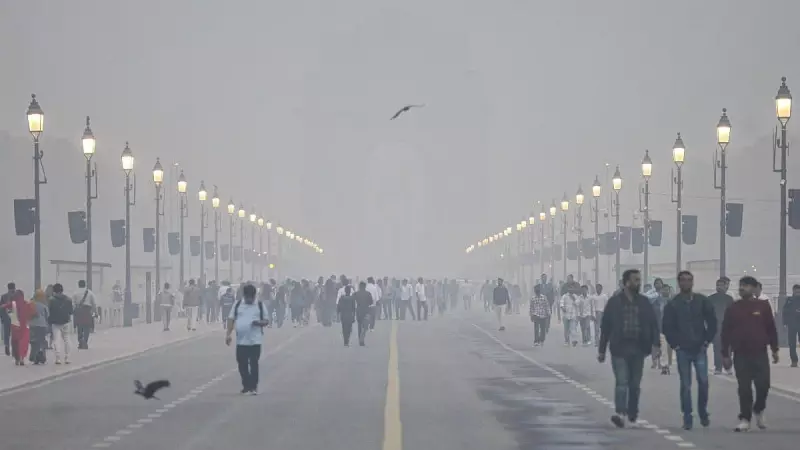
India faces a monumental public health challenge as air pollution continues to choke a vast majority of its urban centers. While official government programs target a limited number of cities for clean air action, the scale of the problem is far more extensive, affecting millions of citizens nationwide.
The Stark Reality: 1,787 Cities Breach Air Quality Norms
Recent data reveals a shocking gap between the official response and the ground reality of India's air pollution crisis. According to information presented in the Lok Sabha, a total of 1,787 cities and towns across the country have been identified as "non-attainment" areas. This technical term signifies that these urban centers have consistently failed to meet the National Ambient Air Quality Standards (NAAQS) for a period exceeding five years.
This list of non-attainment cities was compiled by the Central Pollution Control Board (CPCB). The identification process is rigorous, based on ambient air quality data collected between 2011 and 2015, and further validated with data up to 2021. The sheer number—1,787—paints a grim picture of the widespread nature of toxic air, which is linked to respiratory diseases, cardiovascular problems, and premature deaths.

The Government's Narrow Focus: NCAP's 130-City Target
In contrast to the widespread problem, the government's flagship initiative, the National Clean Air Programme (NCAP), has a much narrower scope. Launched in January 2019, NCAP initially targeted 102 cities. This list was later expanded to include 131 cities, though one city was subsequently dropped, bringing the current count to 130.
These cities are labeled as "NCAP cities" and receive focused attention, funding, and resources to create and implement City Specific Clean Air Action Plans. The program aims to achieve a 20% to 30% reduction in particulate matter (PM10 and PM2.5) concentrations by 2024, using 2017 as the base year for comparison. While this targeted approach allows for concentrated efforts, it leaves over 1,650 other polluted cities without the same level of structured intervention under this national program.
The Challenge of Expanding Clean Air Efforts
The massive discrepancy between the number of polluted cities (1,787) and the cities under NCAP (130) highlights a critical challenge in India's fight for clean air. The government has stated that addressing pollution in all non-attainment cities simultaneously requires a colossal scaling up of resources, planning, and monitoring infrastructure.
Experts argue that while starting with the most critically polluted cities is a logical step, a long-term, phased roadmap to include all affected urban areas is urgently needed. The health burden of air pollution does not respect administrative boundaries, and citizens in non-NCAP cities are equally vulnerable. The situation calls for enhanced capacity building at state and municipal levels, along with increased budgetary allocations to empower local bodies to tackle pollution sources effectively.
The primary sources of pollution across these cities include vehicle emissions, industrial discharge, dust from construction and roads, and the burning of biomass and waste. Tackling these sources requires coordinated action across multiple sectors—transport, energy, industry, and waste management—which is a complex governance task.
India's air pollution crisis is a national emergency affecting nearly 1,800 urban centers. The focused work under the National Clean Air Programme in 130 cities is a crucial beginning, but the data underscores the need for a more expansive and accelerated strategy. Bridging the gap between the identified problem and the scope of the solution is essential to safeguard public health and ensure the right to clean air for all Indians.