

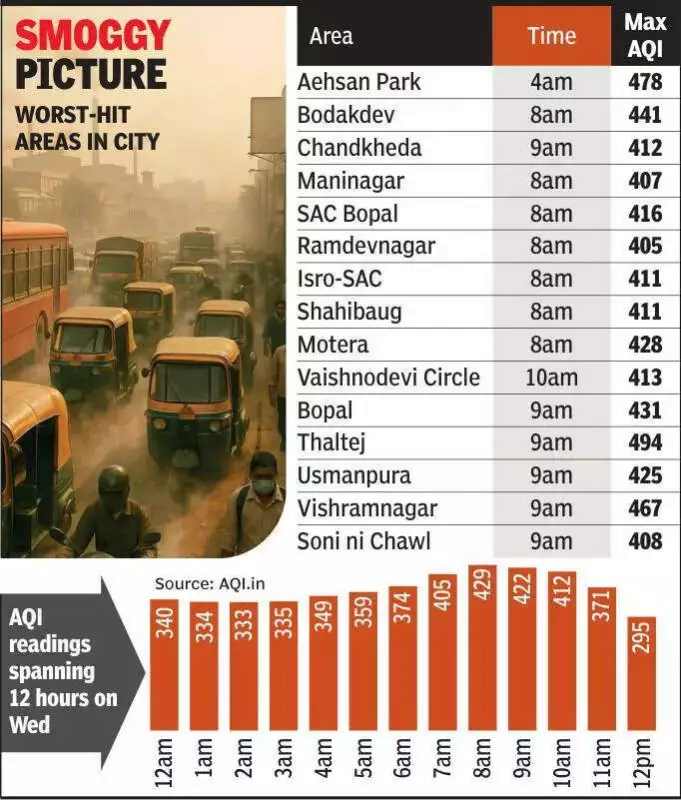
Ahmedabad residents began their Wednesday engulfed in a thick, grey haze, a stark and recurring sign of the city's severe winter air pollution crisis. The day recorded the most dangerous air quality levels of the current season, with the Air Quality Index (AQI) soaring to a staggering 429, deep into the 'hazardous' category.
A Persistent and Worsening Crisis
This alarming peak was not an isolated event. Data reveals that in the 45 days since November 15, Ahmedabad has endured at least seven days where the AQI crossed the 300 mark, indicating very poor to hazardous conditions. The severity of Wednesday's pollution was quantified by AQI.in, which stated that breathing the city's air was equivalent to smoking 7.4 cigarettes in a single day. A week of such exposure equated to 51.8 cigarettes, and a month could mean the toxic impact of 222 cigarettes.
Health advisories were urgent and clear: citizens were urged to stay indoors, wear N95 masks if venturing outside, use air purifiers at home, and ensure vehicle cabin air filters were clean.

Traffic and Construction: The Twin Engines of Pollution
Officials pinpointed traffic congestion as a primary driver of the toxic smog. With an average of 828 new vehicles added to Ahmedabad's roads daily, emissions and gridlock have compounded. Traffic police data showed a direct correlation between vehicle movement and pollution spikes.
The pattern was starkly visible in areas like Thaltej. The AQI there breached 400 at 6 AM, climbed to 467 by 7 AM, and peaked at a frightening 494 around 9 AM, only gradually dipping to 265 by noon—still in the 'poor' range. Pollution levels saw a brief respite around 5 PM before surging again during the evening peak hours from 6 PM to 9 PM. This evening spike was further exacerbated by New Year celebrations that kept vehicles on the roads late into the night.
Government monitoring confirmed that AQI levels crossed 400 across all parts of the city between 7 AM and 10 AM. While Thaltej, particularly along SG Road, was the worst-hit, other areas like Juhapura's Aeshan Park, Vaishnodevi Circle, Bopal, Ramdevnagar, Usmanpura, and the SAC-ISRO stretch also recorded alarmingly high readings. Officials noted that vehicular emissions were worsened by extensive construction activity, including road digging near Iskcon and various bridge projects across the city.
Public Health Under Siege
The human cost of this pollution is already evident in the city's hospitals. Pulmonologist Dr. Tushar Patel reported a noticeable increase in patients complaining of persistent cough and throat irritation. "Patients with pre-existing respiratory conditions must wear proper masks, especially those working outdoors. We have seen cases of breathing difficulty over the past two days," he said, warning that the polluted winter air can trigger dangerous bronchospasm.
Residents are feeling the impact firsthand. Shital Shah, a resident of Motera, shared, "My mother-in-law developed a severe throat infection in the last two days. Even our air purifier, which usually shows 35–40 indoors, crossed 90 on Wednesday."
The pollutant levels of PM2.5 and PM10 remained firmly in the hazardous range, underscoring that the smog blanketing Ahmedabad is far more than a mere inconvenience or visual nuisance—it is a clear and present danger to public health, demanding immediate and sustained action.






